


South Carolina is warm, so most lawns use warm-season grass. But one grass does not fit every yard. The mountains are cool, the coast is salty, and the middle of the state has heavy clay. Each place needs something different.
This guide keeps it simple. You will learn the main types of grass in South Carolina, how to spot them, and how to pick the right one.
Quick answer: Five grasses do most of the work. Bermuda, centipede, zoysia, and St. Augustine love heat. Tall fescue likes the cooler Upstate.
Warm-Season and Cool-Season Grass
Southern grass types fall into two groups.
Warm-season grass grows fastest in summer. It turns tan in winter and turns green again in spring.
Cool-season grass stays green in winter. But it struggles in hot summers. Tall fescue is the only one that works as a full-time lawn here. It does best in the mountains and upper Piedmont.
What Is the Most Common Grass in South Carolina?
Many people say centipede grass. It needs little mowing and little food. It also likes the sandy, acidic soil found across much of the state. Bermuda, zoysia, and St. Augustine are common too. The answer shifts a little by region.
What Are the Four Types of Grass?
It depends on how you sort them. For South Carolina lawns, the four main warm-season types are Bermuda, centipede, zoysia, and St. Augustine. Tall fescue is the cool-season pick. You can also sort every grass into just two groups: warm-season and cool-season.
The Main Types of Grass in South Carolina
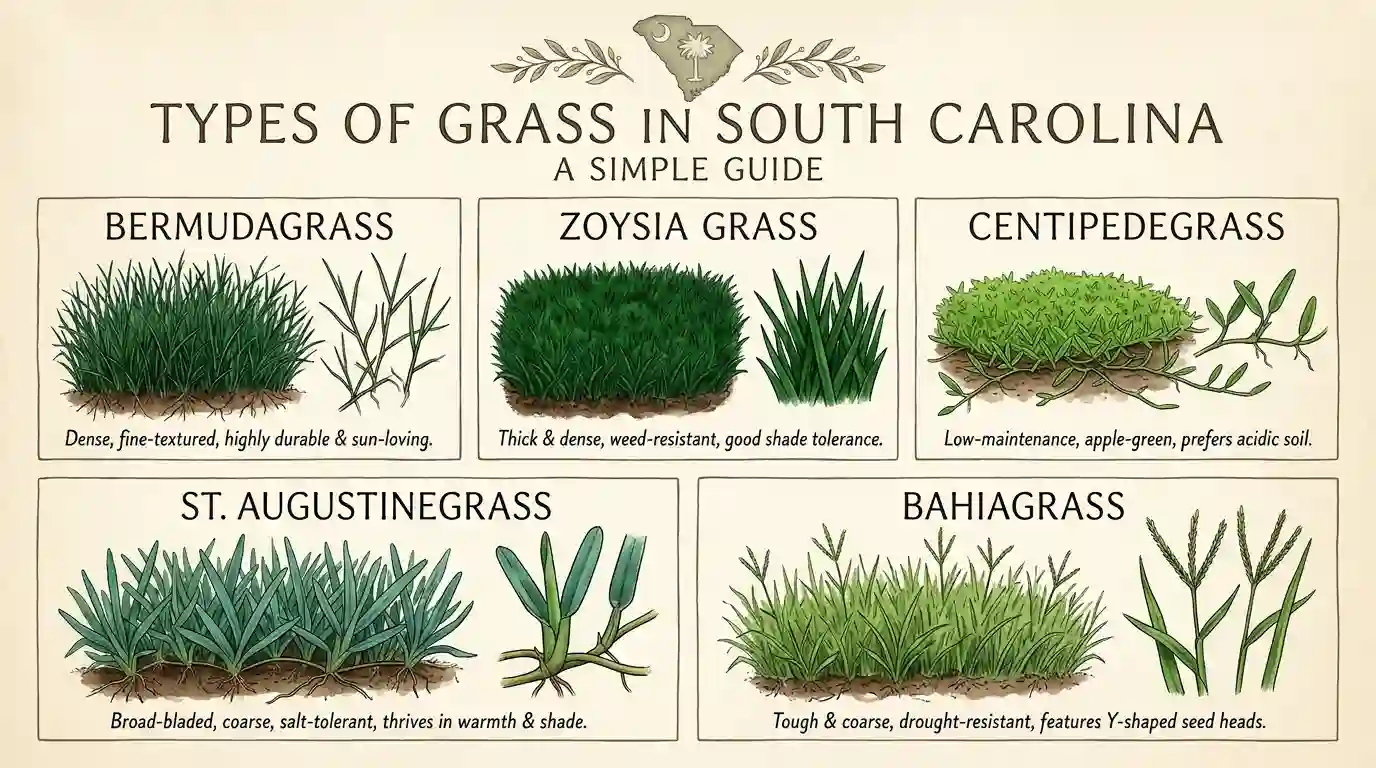
Bermuda Grass
Bermuda is tough.
It tolerates heat, drought, and heavy foot traffic. It also recovers quickly from damage.It has one big weakness: shade. Bermuda needs full sun. Plant it under trees and it will thin out.
It also needs work. In summer, you may mow twice a week. And it likes to sneak into flower beds. Popular types include Tifway 419, Celebration, Latitude 36, and TifTuf.
Centipede Grass
People call it the “lazy man’s grass.” It grows slowly and needs little fertilizer. Its color is a light apple green.
Centipede likes acidic, sandy soil. It does well in full sun or light shade.
But it is not tough. It does not like heavy foot traffic. Too much fertilizer can hurt it. Cold winters can damage it too.
Zoysia Grass
Zoysia grass grows thick and soft. It feels like a carpet. The thick growth keeps many weeds out.
It handles cold better than other warm-season grasses. That is why it works all over the state, even in the Upstate.
The trade-off is speed. Zoysia is slow to fill in. It can also build up thatch, which is a layer of dead material at the base. Popular types include Palisades, Zeon, and Meyer.
St. Augustine Grass
St. Augustine grass has wide, dark blades.
It spreads through thick runners that grow above the ground.
Unlike most warm-season grasses, it grows well in shaded areas. However, it still needs about four to six hours of sunlight each day. Its good salt tolerance also makes it a popular choice for coastal areas.
Cold is its weak spot. Hard freezes can hurt it. Chinch bugs like it too. Popular types include Palmetto, Floratam, and CitraBlue.
Tall Fescue
Tall fescue grows in clumps, not runners. It stays green all winter. It likes clay soil and some shade.
Summer heat is the problem. It can thin out and look patchy. Many people spread new seed each fall to keep it full.
Other Grasses You May See

Bahia grass is coarse and tough. It grows well in dry, sandy, acidic soil. It starts easily from seed and needs a lot of mowing. Some people also find it in their lawn as a weed.
Seashore paspalum handles salt better than almost any grass. It needs full sun and does not like cold.
Carpetgrass grows in wet, acidic soil where little else will. It looks a bit ragged.
Types of Grass in South Carolina With Pictures
Photos can help you name your grass. Here is what to look for.
| Grass | What you will see |
|---|---|
| Bermuda | Fine, thin blades. Dense growth. |
| Centipede | Light apple-green color. Visible stems on top of the soil. |
| Zoysia grass | Stiff blades. Springy, thick feel. |
| St. Augustine grass | Wide, coarse blades. Thick runners. |
| Tall fescue | Wider, rough blades. Grows in clumps. Green in winter. |
| Bahia grass | Coarse blades. Tall seed stalks. |
Photo tip: Take one close-up of the blades. Take one wide shot of the lawn. Use clear captions, like “Centipede grass lawn in South Carolina.”
Start with one question: does it grow in clumps or spread by runners? Clumps mean tall fescue. Runners mean a warm-season grass. Many lawns hold a mix of grasses, so don’t be surprised if you find more than one. A lawn is hardest to name in winter, when it is asleep.
Best Grass by Region
| Region | Good picks |
|---|---|
| Upstate (Greenville, Spartanburg) | Tall fescue, zoysia, Bermuda |
| Midlands (Columbia) | Centipede, Bermuda, zoysia |
| Sandhills | Bahia grass, centipede |
| Coast (Charleston, Myrtle Beach, Hilton Head) | St. Augustine, seashore paspalum, centipede, Bermuda |
Most of the state sits in hardiness zones 7 and 8. The coast runs a little warmer. Tall fescue reaches as far east as Columbia, and then the warm-season grasses take over.
What Is the Best Grass for the South Carolina Coast?
For most coastal lawns, pick St. Augustine. It handles salt and shade. Watch out for winter damage, especially on the northern coast.
If your yard gets heavy salt spray and full sun, try seashore paspalum. Bermuda also does well in sunny coastal yards. Sandy soil drains fast, so water a bit more often.
Best Grass for Your Needs
Shade: St. Augustine on the coast. Zoysia inland. Tall fescue in the Upstate. No grass likes deep shade.
Full sun: Bermuda is the star here.
Clay soil: Tall fescue does well in clay.
Sandy soil: Bahia grass and centipede handle sand.
Wet soil: Carpetgrass.
Dry spells: Bermuda, zoysia, and bahia grass cope well.
Low work: Centipede asks for the least.
Kids and pets: Bermuda bounces back fastest. Zoysia also holds up well. Always check product labels before letting kids and pets onto a treated lawn.
Quick Comparisons
Bermuda vs. zoysia: Both make a fine, thick lawn. Bermuda wants full sun and more mowing. Zoysia accepts some shade but fills in slowly.
Centipede vs. St. Augustine: Centipede needs less feeding. St. Augustine handles shade and salt better but hates cold.
Bermuda vs. centipede: Bermuda takes more traffic. Centipede takes less work.
Seed, Sod, or Plugs?
Seed costs the least but takes the longest. Sod costs the most but gives you a lawn right away. Plugs sit in the middle. They are small pieces of grass that spread over time.
Bermuda, centipede, bahia grass, and tall fescue grow well from seed. Zoysia grass seed exists, but it grows slowly. Most people use sod or plugs for zoysia and St. Augustine.
Prices change with yard size and location. Get a local quote before you decide. If you lack the time or tools, a lawn pro can do the job.
How to Plant a New Lawn

- Test your soil. It tells you the pH and what the soil needs.
- Clear the ground. Remove weeds and loosen the top layer.
- Plant at the right time. See the dates below.
- Water often at first. New grass dries out fast.
- Wait to mow. Let the grass settle in before the first cut.
When to plant: Clemson says to plant warm-season grass between May 1 and May 14. Plant tall fescue in mid-to-late September. That gives it time to root before summer heat.
A Simple Lawn Calendar
Late winter and early spring: The last frost comes in late March on the coast. It comes in April farther inland. Put down pre-emergent weed control before the soil warms to about 55°F.
Early May: Plant warm-season grass.
Summer: Mow often. Keep the blade sharp. Don’t cut too low.
September: Seed tall fescue.
Winter: Warm-season lawns sleep and turn tan. Some people overseed Bermuda with ryegrass for winter color.
Common Weeds in South Carolina
Weeds show up in every lawn. These are the usual ones:
- Crabgrass, the big summer problem
- Henbit and chickweed, which show up in cool weather
- Clover and dandelions, which pop up in spring
- Lawn burweed, which has painful prickly seeds
- Carolina geranium, which pulls out easily by hand
- Plantain and bahia grass, which can sneak into other lawns
Treat winter weeds early, in late fall or early winter. Weeds are harder to kill once they are tall and flowering.
Name the weed first. Name your grass too. A product that is safe on Bermuda can hurt centipede or St. Augustine. If you are unsure, ask your local Extension office.
The best defense is a thick lawn. Thick grass crowds weeds out.
Common Pests and Problems
Chinch bugs love St. Augustine in hot weather.
Thatch and hard soil bother Bermuda and zoysia. Core aeration helps by opening up the soil.
Too much fertilizer is the classic centipede mistake.
Basic Lawn Care
Mowing: Use a sharp blade. Never cut too low, especially with St. Augustine and zoysia.
Fertilizer: Feed the lawn only when it is growing. Centipede needs less than Bermuda.
Water: Water deeply, not often. Short sips make weak roots.
Aeration: Do it when the soil is packed hard.
Lime: Skip it unless a soil test says you need it. Centipede likes acidic soil.
Native Grasses
South Carolina’s state grass is Indian grass. It is a native warm-season grass. Sweetgrass is another native grass, and it matters a lot to local culture. Both are better for garden beds and natural spaces than for a mowed lawn.
Frequently Asked Questions
Centipede grass is often called the most common. Bermuda and zoysia are close behind.
St. Augustine is the usual pick. Seashore paspalum is best for heavy salt in full sun.
For South Carolina lawns: Bermuda, centipede, zoysia, and St. Augustine. Tall fescue is the cool-season option.
Crabgrass, henbit, chickweed, clover, dandelion, lawn burweed, and Carolina geranium.
St. Augustine on the coast. Zoysia inland. Tall fescue in the Upstate.
Centipede.
Yes, but it is slow. Most people use sod or plugs
Warm-season grass goes in from May 1 to 14. Tall fescue goes in during mid-to-late September.
Yes. Repairs and natural spread often leave a mix.
Final Thoughts
No single grass is best for every yard. Bermuda fits sunny, busy lawns. Centipede fits low-work lawns. Zoysia gives a thick, cold-hardy carpet. St. Augustine fits shade and the coast. Tall fescue fits the Upstate.
Look at your sun, soil, and region. Think about how much work you want to do. Then pick your grass. For one last check, read the Clemson Extension guides before you plant.

Jessica Morgan writes easy-to-understand guides about grass varieties, lawn care, growing conditions, and seasonal lawn maintenance. She focuses on practical information that helps readers identify different grasses, understand their needs, and make better choices for healthy lawns.