

Florida is hot, wet, and sandy. That makes it hard to grow a lawn. The right grass makes it easy. The wrong grass costs you time and money.
This guide covers the main types of grass in Florida. You will learn what each one does well, what it costs, and how to care for it. By the end, you will know which grass fits your yard.

Quick Answer: The Best Types of Grass in Florida
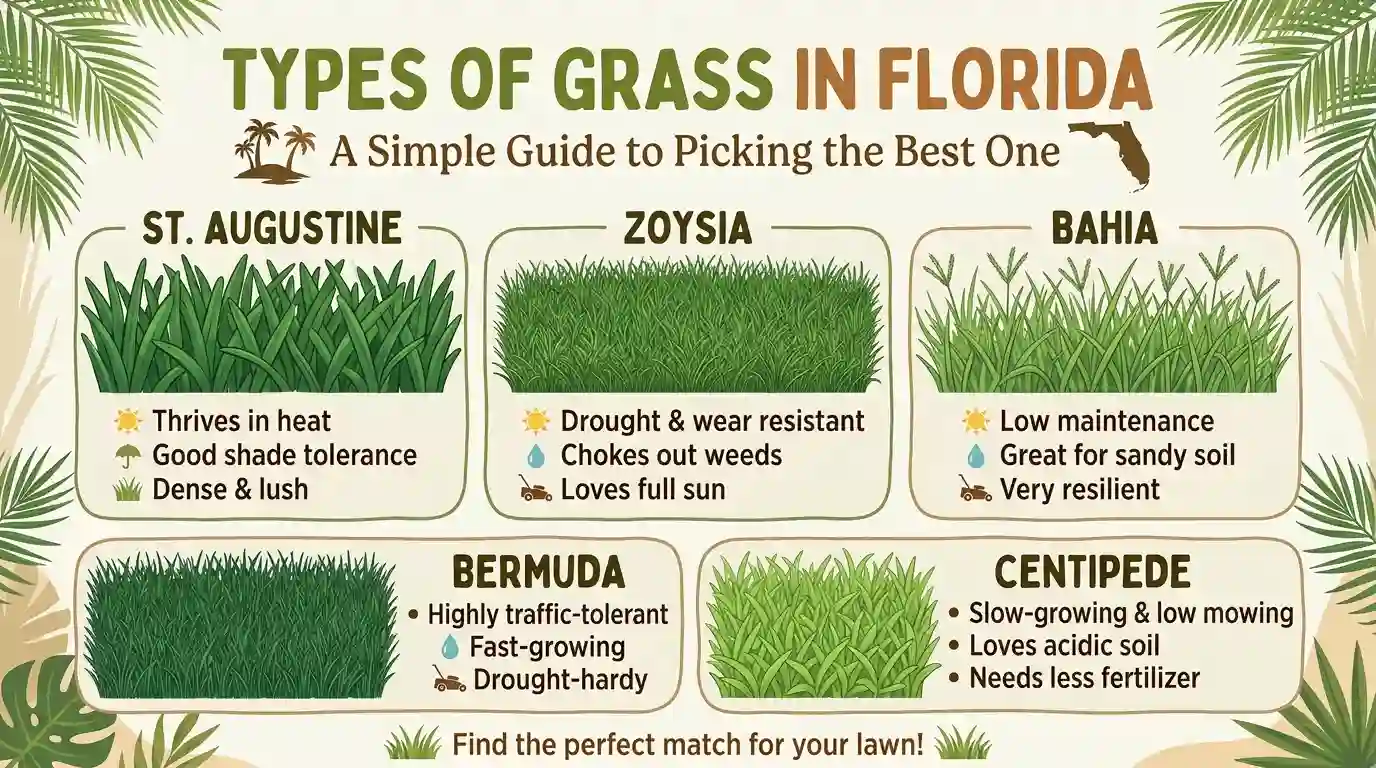
Most Florida yards do well with one of six grasses:
- St. Augustinegrass: The most popular. Best for shade.
- Zoysiagrass: Soft and thick. Good for foot traffic.
- Bermudagrass: Tough and fast. Best for full sun.
- Bahiagrass: Cheap and easy. Good for sandy soil.
- Centipedegrass: Slow and low effort. Good for North Florida.
- Seashore paspalum: Handles salt. Best for the coast.
Want just three? Most homeowners pick St. Augustinegrass, Bermudagrass, or zoysiagrass.
Why Florida Lawns Are Different
Florida has a long, warm growing season. So lawns here need warm-season grasses. Many types of lawn grass sold in the U.S. are cool-season grasses, like fescue and ryegrass. They struggle in Florida summers.
The state spans USDA hardiness zones 8 through 11. A grass that thrives in Pensacola may struggle in Miami. In North Florida, lawns often turn tan in winter. In Central and South Florida, most lawns stay green all year.
Florida lawns also face a few tough problems:
- Humidity. It helps fungus grow.
- Sandy soil. Water drains fast and takes nutrients with it.
- A long bug season. Chinch bugs and mole crickets love Florida.
- Salt. Ocean spray and brackish water hurt many grasses.
The next section shows which grass handles which problem.
The 6 Most Common Types of Grass in Florida
1. St. Augustinegrass
St. Augustinegrass is the most popular lawn grass in Florida.
It forms a thick lawn with wide, blue-green blades. This grass tolerates heat, humidity, and some salt spray. It also grows in shade better than most other warm-season grasses.
- Best for: Most home lawns, especially shady ones
- Mowing height: 3 to 4 inches
- Common cultivars: Floratam, Palmetto, Seville, BitterBlue, Raleigh
- Watch out for: Chinch bugs, gray leaf spot, thatch, and heavy foot traffic
The type matters. Floratam grows fast and loves sun, but it handles cold less well. Palmetto and Seville do better in shade. Raleigh is often chosen where winters run cooler. Ask your sod seller which one fits your area.
One more thing: you cannot buy St. Augustinegrass as seed. You plant it as sod, plugs, or sprigs.
2. Zoysiagrass
Zoysiagrass makes a soft, thick, emerald lawn. It comes from eastern Asia. It handles heat, light shade, and foot traffic. Golf courses and sports fields use it too.
It grows slowly. That means less mowing, but it takes longer to fill in. It also recovers slowly if it gets damaged.
- Best for: Lawns with kids, pets, and a love of soft turf
- Mowing height: 1 to 2.5 inches
- Common cultivars: Empire, El Toro, Zeon
- Watch out for: Large patch, dollar spot, thatch, and too much water
A UF/IFAS Extension agent in Ocala, Amanda Marek, says overwatering is the top zoysia mistake, especially in winter. Water only when the blades fold and turn blue-gray. Plant it as sod. Seed is not a good choice.
3. Bermudagrass
Bermudagrass is tough. It grows fast, grows thick, and bounces back from damage. It handles heat, drought, and some salt. That is why you see it on golf courses and ball fields.
This grass thrives in full sun but struggles in shady areas. Regular mowing is also necessary to keep it neat and healthy.
- Best for: Sunny yards with heavy use
- Mowing height: 1 to 2 inches
- Common cultivars: Tifway 419, Celebration, Latitude 36
- Watch out for: Mole crickets, nematodes, dollar spot, and spreading into flower beds
Florida soil is often slightly acidic. Test it now and then. Bermudagrass likes a soil pH between 6.0 and 7.0.

4. Bahiagrass
Bahiagrass is the easy one.
Introduced to the U.S. from Brazil in 1914, this grass grows well in poor, sandy soil. It also needs very little water or fertilizer to thrive. That makes it great for big yards and low budgets.
It does not look fancy. The blades are coarse and the lawn is a bit open. Weeds can sneak in. Tall seed stalks also pop up in summer and dull your mower blade.
- Best for: Large lawns, sandy soil, and low cost
- Mowing height: 3 to 4 inches, every 7 to 14 days when growing
- Common cultivars: Pensacola, Argentine, Paraguay 22
- Watch out for: Weeds and seed heads
Sod or seed works best. Plugs and sprigs take too long to fill in.
5. Centipedegrass
People call centipedegrass the “lazy man’s grass.”
Introduced in 1916, this grass originated in Southeast Asia. It thrives in poor, acidic soil and requires minimal mowing and fertilizer.
This grass grows widely across North and Central Florida, particularly in the Panhandle. However, salty or alkaline soil can limit its growth. That rules out many South Florida beaches.
- Best for: Low-effort lawns in North Florida
- Mowing height: 1 to 2 inches
- Common cultivars: Tennessee Hardy, Oaklawn, TifBlair
- Watch out for: Nematodes, ground pearls, and heavy foot traffic
Do not push it with extra nitrogen. Too much fertilizer causes thatch and disease.
6. Seashore Paspalum
Seashore paspalum handles salt better than any other warm-season grass. It even handles brackish irrigation water. That makes it a top pick for coastal homes in places like Miami, Tampa, and Naples.
This grass requires regular care because of its fast growth. Too much water or fertilizer can cause thatch to build up. Many weed killers can also damage the grass.
- Best for: Coastal and waterfront yards
- Mowing height: 1 to 2 inches
- Common cultivars: SeaIsle 1, Platinum TE, Salam, Supreme
- Watch out for: Thatch, high upkeep, and few herbicide choices
Other Grasses You Might See
Carpetgrass grows in low, wet spots with poor drainage. It is coarse and does not handle drought or heavy wear.
Buffalograss is a North American native. It is easy to care for in dry places. But it struggles in Florida’s humidity and soggy sandy soil. Most homeowners should skip it.
Types of Grass in Florida at a Glance
| Grass | Shade | Salt | Drought | Traffic | Mowing Height | Upkeep | Sod Cost per sq ft |
|---|---|---|---|---|---|---|---|
| St. Augustinegrass | High | High | Moderate | Low | 3 to 4 in | Moderate to high | $0.45 to $0.90 |
| Zoysiagrass | Moderate | Good | Good, may brown | High, slow recovery | 1 to 2.5 in | Moderate to high | $0.50 to $0.80 |
| Bermudagrass | Low | Good | Excellent | High | 1 to 2 in | High | $0.45 to $0.85 |
| Bahiagrass | Low | Low | Excellent | Low to moderate | 3 to 4 in | Low | $0.20 to $0.40 |
| Centipedegrass | Moderate | Low | Moderate | Low | 1 to 2 in | Low | $0.80 to $0.90 |
| Seashore Paspalum | Low to moderate | Excellent | Good | Moderate | 1 to 2 in | High | Ask local suppliers |
Best Grass by Region
North Florida and the Panhandle. Think Pensacola, Tallahassee, and Jacksonville. St. Augustinegrass, Bermudagrass, and zoysiagrass all do well. Centipedegrass and bahiagrass suit the soil here. Expect some winter browning.
Central Florida. Think Orlando and Tampa. St. Augustinegrass leads. Zoysiagrass and Bermudagrass are strong picks. Bahiagrass works well on big, low-effort lots.
South Florida. Think Miami, Fort Lauderdale, and Fort Myers. St. Augustinegrass is the most common. Bermudagrass and zoysiagrass also do well. Seashore paspalum is popular near the water.
Coastal yards. Choose a salt-tolerant grass. Seashore paspalum is best. St. Augustinegrass is a good second choice. Centipedegrass and bahiagrass handle salt poorly.
How to Choose the Right Grass
Ask yourself five questions:
- How much sun does the yard get? Shade favors St. Augustinegrass. Full sun opens every option.
- How much will people and pets use it? Bermudagrass and zoysiagrass handle play best.
- What is your soil like? Sandy soil suits bahiagrass and centipedegrass. Salty soil needs seashore paspalum.
- How much work do you want? Bahiagrass and centipedegrass need the least. Bermudagrass and paspalum need the most.
- Are there rules? Check your city, county, or HOA for approved grasses and watering limits.
Some situations have a clear winner:
- Dogs and kids: Bermudagrass. It heals fast, even from dog urine spots.
- Shady yard with big trees: St. Augustinegrass, like Palmetto.
- New build or bare sandy lot: Bahiagrass is cheap and tough.
- Waterfront home: Seashore paspalum.
No grass grows well in deep shade. Under thick trees, use mulch or native plants instead.
How Much Does a Florida Lawn Cost?
Sod is the fastest way to a green lawn. It is also the most expensive. One pallet covers about 450 square feet. HomeAdvisor’s 2025 guide puts a pallet at about $90 to $180 for bahiagrass. St. Augustinegrass runs about $200 to $405.
Pros charge more. Lawn by Season estimates $1.10 to $1.80 per square foot installed in Florida. Grading or new topsoil adds $0.40 to $2.00 per square foot. South Florida costs more than North Florida.
Seed costs less. But St. Augustinegrass is not sold as seed, and zoysia seed is not a good choice. Those two mean sod, plugs, or sprigs. Treat every price here as a rough guide. Prices change with the supplier and the season.

How to Plant Grass in Florida
Plant warm-season grass from spring through early summer. Warm weather helps roots take hold. Skip late fall, especially in North Florida.
Pick your method:
- Sod: Fastest. Best for zoysia and St. Augustinegrass. It also keeps weeds out.
- Plugs and sprigs: Cheaper, but slow. They suit St. Augustinegrass, centipedegrass, and Bermudagrass. Avoid them for bahiagrass.
- Seed: Cheapest. Works for bahiagrass, centipedegrass, and Bermudagrass.
Then follow these steps:
- Clear weeds, rocks, and old grass.
- Test the soil. Fix the pH if needed.
- Level the ground and add compost if the soil is very sandy.
- Lay the sod or plant your plugs or seed.
- Water often at first. Keep the soil damp until roots grow.
- Hold off on heavy mowing and foot traffic for a few weeks.
How to Mow Florida Grass
Mowing the right way keeps grass thick. Thick grass blocks weeds.
- Follow the one-third rule. Never cut more than one third of the blade at once.
- Use the height in the table above. Tall grasses need tall cuts.
- Keep your mower blade sharp. A dull blade tears grass.
- Mow more often in summer. St. Augustinegrass needs about a weekly cut. Bahiagrass needs one every 7 to 14 days.
- Bahiagrass seed stalks are tough. A sharp blade helps.
Water and Feed Your Lawn
Water deeply, but not often. This builds deep roots. Check your water management district too. Some limit the days you can water.
Florida also has fertilizer rules. More than half of the state’s counties have an ordinance. Most ban nitrogen and phosphorus from June 1 to September 30. That is the rainy season. Some also ban fertilizer during a hurricane or tropical storm watch. Many ask for slow-release nitrogen and no fertilizer near water. “Summer blends” with iron are usually fine. See Seminole County’s rules for an example. Your county may differ.
A soil test helps. It shows your pH and what the soil lacks. Many county UF/IFAS Extension offices offer testing.
| Season | Months | What to Do |
|---|---|---|
| Winter | December to February | Growth is slow. Skip fertilizer. Test your soil. |
| Spring | March to May | Feed once with slow-release nitrogen, before June 1. |
| Summer | June to September | Skip nitrogen and phosphorus where banned. Watch for bugs and fungus. |
| Fall | October to November | In Central Florida, feed by mid-November. Overseed if you want. |
Pests, Diseases, and Weeds
Humid weather brings bugs and fungus. Catch problems early.
| Grass | Common Problems |
|---|---|
| St. Augustinegrass | Chinch bugs, gray leaf spot, thatch |
| Zoysiagrass | Large patch, dollar spot |
| Bermudagrass | Mole crickets, nematodes, dollar spot |
| Bahiagrass | Mole crickets, dollar spot in poor soil |
| Centipedegrass | Nematodes, ground pearls, centipede decline |
| Seashore Paspalum | Large patch, dollar spot |
Common Florida lawn weeds include crabgrass, nutsedge, torpedograss, sandspurs, and dollarweed. Dollarweed loves soggy soil, so cut back on water if you see it.
The best weed fighter is thick grass. Mow at the right height and feed on time. Before you spray, name your weed and your grass. A weed killer that is safe for one grass can hurt another. Seashore paspalum is one of the touchy ones.
Why Is My Lawn Brown in Winter?
Often it is not dead. It is resting. Warm-season grasses slow down or go dormant when it gets cold. Zoysiagrass and Bermudagrass go dormant first. Bahiagrass thins out in drought. The lawn turns green again in spring.
In North and Central Florida, some people overseed with perennial ryegrass. Ryegrass sprouts when the summer grass rests. It keeps the lawn green until spring. Sow it from October to early December, after daytime highs fall to the low to mid 70s. South Florida rarely needs it.
How to Identify the Grass in Your Yard
Check the blades and how the grass spreads. Stolons are runners that crawl above the ground. Rhizomes are stems that grow below it.
| Grass | Blade | Color | How It Spreads |
|---|---|---|---|
| St. Augustinegrass | Wide, coarse | Blue-green | Stolons |
| Zoysiagrass | Fine | Emerald | Rhizomes |
| Bermudagrass | Fine | Medium to dark green | Rhizomes |
| Bahiagrass | Medium to coarse | Light green | Rhizomes, tall seed heads |
| Centipedegrass | Medium | Light green | Stolons |
| Seashore Paspalum | Fine | Blue-green | Dense and low |
Still unsure? Compare your lawn with labeled photos from your local UF/IFAS Extension office. A lawn pro can also tell you.

When Grass Is Not the Answer
Some spots just will not grow turf. Think deep shade, soggy low areas, or steep slopes. Try mulch, native plants, or a Florida-friendly landscape instead. These need less water and less mowing.
Not every grass in Florida is a lawn grass. Pink muhly grass and fakahatchee grass are native grasses used in garden beds. Maidencane and cordgrass grow at lake edges. Grasses are a huge plant family with thousands of species worldwide. Only a few make good lawns. Near lakes, check local rules before you plant or pull anything.
After a Hurricane
Salt water and flooding can hurt a lawn. Salt-tolerant grasses, like seashore paspalum and St. Augustinegrass, recover best. Flush salt off with rain or fresh water. Mow as usual. Wait to see what survives before you replace sod. Check local rules too. Some ordinances ban fertilizer during a storm watch.
FAQs
St. Augustinegrass suits most yards, especially shady ones. Bermudagrass and zoysiagrass fit sunny, busy lawns. Bahiagrass and centipedegrass fit low-effort owners. Seashore paspalum is the coastal pick.
St. Augustinegrass. It handles heat, humidity, and some shade.
Bahiagrass and centipedegrass. Both need little water, fertilizer, and mowing.
St. Augustinegrass. It still needs a few hours of filtered sun each day.
Crabgrass, nutsedge, torpedograss, sandspurs, and dollarweed. Thick, well-mowed grass keeps most of them out.
When is the best time to plant grass in Florida?
Spring through early summer. Roots need warm weather to take hold.
Final Thoughts
There is no single best answer among the types of grass in Florida. Match the grass to your sun, soil, region, and free time. St. Augustinegrass fits most yards. Bermudagrass and zoysiagrass shine where lawns get heavy use. Bahiagrass and centipedegrass reward low effort. Seashore paspalum rules the coast.
Pick one, plant it at the right time, and mow it well. For advice on your exact area, call your local UF/IFAS Extension office.

Jessica Morgan writes easy-to-understand guides about grass varieties, lawn care, growing conditions, and seasonal lawn maintenance. She focuses on practical information that helps readers identify different grasses, understand their needs, and make better choices for healthy lawns.