


Growing grass in North Carolina is a puzzle. Summers are hot. Winters can be cold. Few grasses love both.
The good news is that you have many choices. Some grasses love heat. Others love cool air. Each one fits a different yard.
This guide covers the types of grass in North Carolina. You will learn where each one grows. You will also learn how to plant it, feed it, and protect it. We keep it simple. Let’s start.
Why North Carolina Is Hard on Grass
North Carolina sits in the “transition zone.” That means two climates meet here.
North of us, summers are mild. Cool-season grass does well there. South of us, winters are mild. Warm-season grass does well there. We get a bit of both.
So no grass is perfect here. Every grass has a weak season. Your job is to pick the one with the weakness you can live with.
The state also has a lot of turf. NC State Extension says there are about two million acres. Homes make up about 60% of it. The rest is on golf courses, sports fields, sod farms, parks, roadsides, and school grounds.
That is a lot of grass. So a smart pick matters.
Cool-Season vs. Warm-Season Grass
Grasses fall into two groups. This is the first thing to learn.
Cool-season grasses grow best between 60 and 75°F. They are busy in spring and fall. Most stay green in winter. They struggle in hot summers.
Warm-season grasses grow best between 80 and 95°F. They love summer heat. They turn tan after the first hard frost. Then they wake up in spring.
Tall fescue is the most common grass in the state. It is a cool-season grass. Bermudagrass comes next. It is a warm-season grass.
The Three Regions of North Carolina
Where you live matters most. The state has three main regions.
Mountains (Western North Carolina)
Summers are cool here. Winters are cold. That suits cool-season grass.
If you want types of grass in western North Carolina, start with tall fescue. Many lawns blend it with Kentucky bluegrass and fine fescue. Warm-season grass often struggles in the mountains. The season is short. Cold can harm it.
Frost comes late up here. In towns like Boone, the last spring frost is near May 1.
Piedmont (Central North Carolina)
The Piedmont sits between the mountains and the coast. It includes Charlotte, Greensboro, and the Raleigh-Durham area.
This is the true transition zone. Both grass types can grow here. Neither is perfect. Fescue gets stressed in July. Warm-season grass turns brown in winter.
Coastal Plain (Eastern North Carolina)
Summers are hot and humid. Winters are mild. The Atlantic Ocean softens the cold.
Warm-season grass wins here. Bermudagrass, zoysiagrass, and centipedegrass are common. St. Augustinegrass grows near the coast. Last frost comes early. In Wilmington, it is around mid-March.
What Are the Most Common Types of Grass?
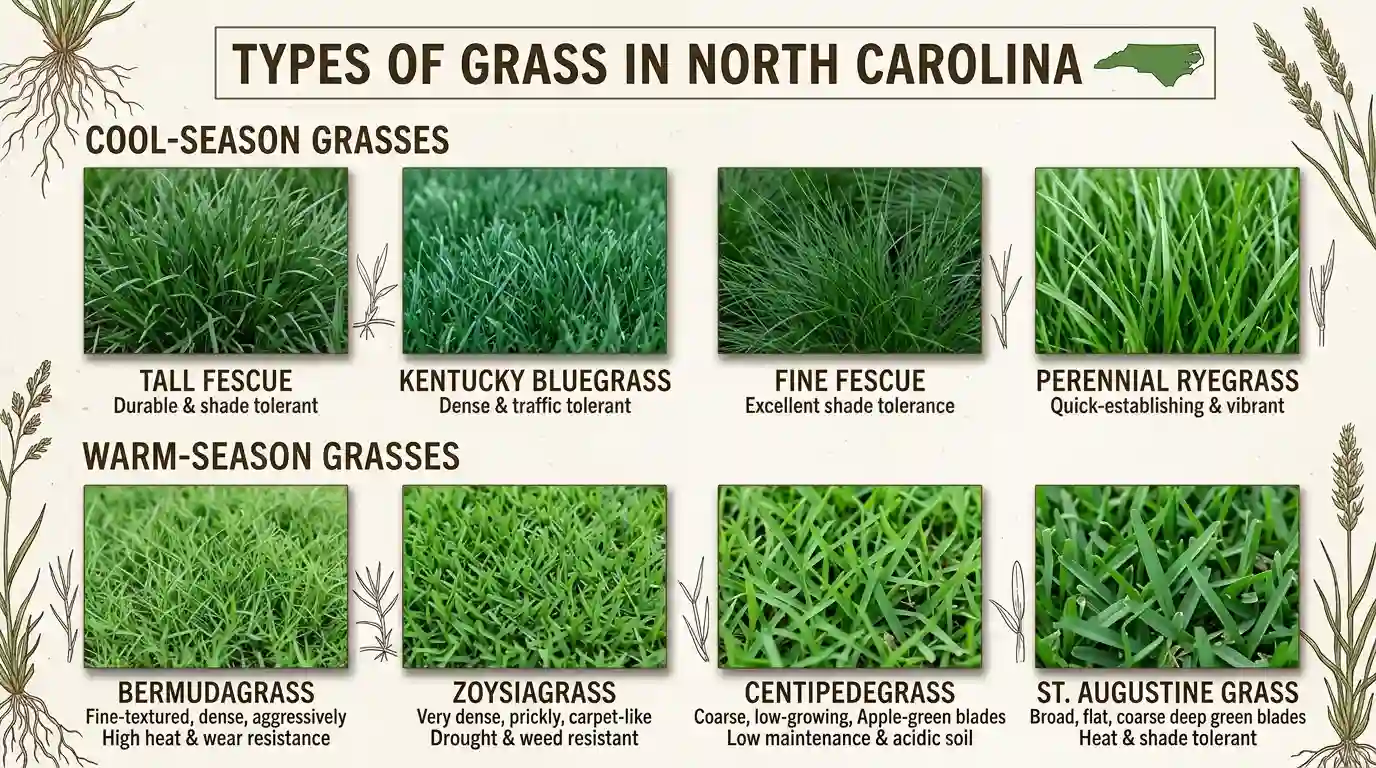
Here are the most common types of grass in North Carolina:
- Tall fescue
- Bermudagrass
- Zoysiagrass
- Centipedegrass
- St. Augustinegrass
- Kentucky bluegrass
- Fine fescue
- Perennial ryegrass
Tall fescue, Kentucky bluegrass, fine fescue, and ryegrass are cool-season. The rest are warm-season.
What Are the Four Types of Grass?
People ask this a lot. The answer depends on how you group grass.
For a North Carolina lawn, the four main picks are:
- Tall fescue
- Bermudagrass
- Zoysiagrass
- Centipedegrass
These four cover most yards in the state. Tall fescue handles shade. Bermuda handles heavy play. Zoysia makes a thick carpet. Centipede needs little care.
You can also group grass by season. That gives you two groups. Cool-season and warm-season.

Cool-Season Grasses in North Carolina
Let’s look at each cool-season grass.
Tall Fescue
Tall fescue is the top lawn grass in the state.
It grows well in the mountains and the Piedmont. Its leaves stay fairly green throughout the year.
It grows in clumps. It does not spread much. So bare spots need new seed.
Summer is its weak spot. Heat and humidity can cause brown patch. That is a lawn disease. We cover it below.
If you search for fescue grass, you will see many kinds. Tall fescue, turf-type tall fescue, and fine fescue are the best known.
Kentucky Bluegrass
Kentucky bluegrass is not blue.
Its color is a rich green, and the blades are soft and fine.
It spreads by underground stems. That helps it fill gaps. It is the second most common cool-season grass in the state.
It likes cool weather. So it fits the mountains best. Most people mix it with tall fescue. It rarely stands alone.
Fine Fescue
Fine fescue has thin, needle-like blades. It is the shade expert. It grows well under trees.It needs little fertilizer. But it does not like heat. It also dislikes heavy foot traffic. So it works best in a blend.
Perennial Ryegrass and Annual Ryegrass
Ryegrass sprouts fast. That makes it great for quick cover. It also helps stop erosion.
Perennial ryegrass often goes into seed blends. Annual ryegrass lasts one season. People use it to add green to a brown lawn in winter.
Other Cool-Season Grasses
Creeping bentgrass is common on golf greens. Rough bluegrass grows in damp, shady spots. Most homeowners skip both.
Warm-Season Grasses in North Carolina
Now for the warm-season group.
Bermuda Grass NC
Bermudagrass is a favorite for sunny yards. Search for bermuda grass NC and you will see it all over the Piedmont and the coast.
It spreads by runners. Some run above ground. Some run below.
This grass thrives in hot weather and handles dry conditions well. It also recovers quickly from the wear caused by kids and pets. For the best growth, plant it in an area with full sun. Shade will thin it out. It turns brown after frost. And it can sneak into flower beds. Edging helps.
Some Bermuda types are bred for extra drought strength. TifTuf is one example.
Zoysia Grass in NC
Zoysia is a thick, soft grass. It feels like a carpet under bare feet. It came from Asia.
If you wonder about zoysia grass in NC, here is the short story.
This grass thrives in the Piedmont and along the coast. Compared with Bermuda grass, it tolerates light shade better. Its dense growth also helps keep weeds from taking over.
The downside is speed. Zoysia grows slowly. It also heals slowly. Be patient after you plant it. Like other warm-season grass, it turns tan in winter.
Centipede Grass
Centipede grass is slow and low. It has wide, pale green blades.
It loves sandy, acidic soil. That is common on the Coastal Plain.
This grass grows well with minimal fertilizer and needs mowing less often. However, it cannot handle heavy foot traffic well. High soil pH can also limit its growth. Too much fertilizer can hurt it. A harsh winter can set it back.
What Is Poor Man’s Grass?
Centipede grass is often called “poor man’s grass.” You may also hear “lazy man’s grass.”
Why the names? It grows well in poor soil. It needs less feeding, less mowing, and less water than many grasses. So it costs less to keep.
If you want a low-work lawn in the east, it is a good pick.
St. Augustinegrass
St. Augustinegrass has broad, flat, coarse blades. It handles shade better than any other warm-season grass.
But it hates cold. So it only works near the coast. Inland winters can kill it. It is usually sold as sod.
Bahia Grass
Bahia grass is tough.
This grass tolerates dry conditions and can grow in sandy soil with few nutrients.
It has a coarse, open look. You often see it on roadsides and pastures. A few people use it for plain, low-care lawns in the east.
Carpetgrass and Buffalograss
NC State lists both as warm-season grasses. Carpetgrass likes wet, low ground. Buffalograss needs little water. Neither is common in home lawns here.
Quick Comparison Chart
| Grass | Season | Sun Needs | Best Region | Care Level |
|---|---|---|---|---|
| Tall fescue | Cool | Sun to part shade | Mountains, Piedmont | Medium |
| Kentucky bluegrass | Cool | Sun to light shade | Mountains | Medium to high |
| Fine fescue | Cool | Shade | Mountains, Piedmont | Low |
| Bermudagrass | Warm | Full sun | Piedmont, Coast | High |
| Zoysiagrass | Warm | Sun to light shade | Piedmont, Coast | Low to medium |
| Centipedegrass | Warm | Sun to light shade | Coastal Plain | Very low |
| St. Augustinegrass | Warm | Shade friendly | Coast | Medium to high |
Best Grass by City
Your city can help you choose. Here is a quick guide.
Charlotte. Tall fescue is the most common lawn. Sunny yards can handle Bermuda or zoysia. Shady lots do best with fescue.
Greensboro. The Triad sits in the heart of the transition zone. Tall fescue, Bermuda, and zoysia all grow here. Pick based on your sun.
Raleigh and Durham. The Triangle also sits in the Piedmont. Fescue is the usual choice. Bermuda and zoysia are strong picks for open, sunny lawns.
Wilmington. Heat and humidity favor warm-season grass. Centipede, zoysia, Bermuda, and St. Augustine are common. Salt and sandy soil matter here. Centipede handles sand well.
Boone and Asheville. Think cool-season. Tall fescue, Kentucky bluegrass, and fine fescue fit best.
How to Tell Grass Types Apart
Photos help a lot. If you search for types of grass in North Carolina images, you will see how different each blade looks. Use photos to match your own lawn. Take a close-up of your grass. Compare it side by side.
Here are some easy clues.
Check how it grows. Tall fescue and fine fescue grow in bunches. They do not form runners. Bermuda, zoysia, centipede, and St. Augustine spread with runners. Kentucky bluegrass spreads underground.
Look at the blade. Tall fescue has wide, rough blades. Fine fescue is thin like thread. St. Augustine is broad and flat. Kentucky bluegrass has a boat-shaped tip.
Check the seed head. Bermuda often shows a seed head shaped like a bird’s foot. You may see it even in mowed grass.
Feel the lawn. Zoysia feels springy and thick. Centipede stays low to the ground.
NC State’s TurfFiles site has a page for each grass. Each page has photos. It is a great place to compare.
A Few Terms Made Simple
You will see these words a lot. Here is what they mean.
- Rhizomes. Stems that grow under the soil. They help grass spread.
- Stolons. Stems that creep along the top of the soil. They also help grass spread.
- Dormancy. A rest period. The grass turns brown but is not dead. Warm-season grass goes dormant in winter.
- Winterkill. Cold damage that kills grass. It hits grass that is not hardy enough.
- Overseeding. Spreading new seed over an existing lawn. It fills thin spots.
- Thatch. A layer of dead stems and roots above the soil. Too much blocks water and air.
How to Start a Lawn: Seed, Sod, Plugs, and Sprigs
You can start grass in four ways. Each has pros and cons.
Seed. It is the cheapest. It works well for tall fescue, fine fescue, Kentucky bluegrass, and ryegrass. Bermuda and centipede can also grow from seed. It takes longer to fill in.
Sod. These are strips of live grass. You roll them out like a rug. You get a lawn fast. It costs more. St. Augustine is almost always sold this way. Zoysia and Bermuda are also popular as sod.
Plugs. These are small squares of grass. You plant them in rows. They spread over time. Zoysia and St. Augustine are often planted this way. It costs less than sod but takes longer.
Sprigs. These are pieces of runners. Farmers and golf courses often use them for Bermuda. They need lots of water at first.

A Quick Guide to Grass Seed
If you plan to use grass seed, a few tips will help.
Pick seed for your region. Tall fescue seed fits the mountains and the Piedmont. Bermuda seed fits sunny yards in the Piedmont and the east.
Read the label. Look for the grass type. Check the purity and germination numbers. Look at the weed seed amount. Pick seed with very little weed seed.
Use a blend for mixed yards. Sunny and shady spots may need different grasses. A blend can cover both.
Prepare the soil. Remove weeds and debris. Loosen the top layer. Seed needs contact with soil.
Water often at first. Keep the top layer damp until seeds sprout. Then water less often but deeper.
Get a Soil Test First
A soil test is cheap. It saves a lot of guesswork.
A soil test reveals your soil’s pH and nutrient levels. That tells you what your soil needs. Some grasses, like centipede, like acidic soil. Others need a different pH.
You can send samples to the NC Department of Agriculture. NC State Extension can also help. Your local county center can explain the results.
When to Plant Grass in North Carolina
Timing may matter more than the grass you pick.
Cool-season grasses: Plant in fall. The best window is mid-August to about October 1. In the mountains, start earlier. In the Piedmont and on the coast, aim closer to October 1.
Why fall? Soil is warm. Air is cooler. Weeds are slowing down. Seedlings get strong before winter.
Spring seeding often fails. Summer heat arrives before roots grow deep.
Warm-season grasses: Plant in late spring and summer. You can seed from about March 1 to July 1. You can also lay sod through summer. Wait until soil is warm. Cold soil slows growth.

Yearly Lawn Calendar
| Season | Cool-Season Grass (Fescue, Bluegrass) | Warm-Season Grass (Bermuda, Zoysia, Centipede) |
|---|---|---|
| Early spring | Apply pre-emergent before soil hits 55°F | Apply pre-emergent before soil hits 55°F |
| Late spring | Mow and water as needed | Plant or sod; start feeding |
| Summer | Water deeply; watch for brown patch | Peak growth; mow often |
| Early fall | Seed, overseed, and feed | Stop feeding; watch for pests |
| Late fall | Keep mowing until growth stops | Grass goes dormant and turns tan |
| Winter | Stays fairly green | Dormant; avoid heavy traffic |
Grass Weeds in North Carolina
Some grasses are not welcome in a lawn. They are weeds.
The most common types of grass weeds in North Carolina are:
- Crabgrass. It sprouts in spring and thrives in summer.
- Goosegrass. It grows in packed, hard soil.
- Foxtail. It makes seed heads that look like tails.
- Dallisgrass. It forms clumps that stick out of a lawn.
- Nimblewill. It spreads in cool-season lawns.
- Japanese stiltgrass. It grows in shade and along edges.
- Annual bluegrass. It pops up in cool weather and makes seed heads.
- Sandbur. Its seed burrs hurt bare feet.
- Orchardgrass and broomsedge. Both grow in clumps and look out of place in a lawn.
Look-Alikes: Sedges
Nutsedge looks like grass but is not a true grass. It has triangle-shaped stems. Yellow nutsedge and purple nutsedge are the two kinds. Green kyllinga is another sedge you may see. These need different weed killers than grassy weeds.
Broadleaf Weeds
Broadleaf weeds are not grass at all. Common ones are chickweed, henbit, clover, dandelion, wild violet, and doveweed.
How to Fight Weeds
Start with a thick lawn. Thick grass leaves little room for weeds. Mow at the right height. Water deeply but less often.
Timing helps, too. Put down a pre-emergent herbicide in early spring. Do this before soil reaches about 55°F. That is when crabgrass starts to sprout. If you plan to seed in spring, use a product that is safe for seedlings. Siduron is one example. Many regular products stop all seeds.
Always read the label. Follow it exactly.
Common Lawn Diseases
Hot, wet weather can bring disease. Here are the main ones in North Carolina.
Brown patch. This hits tall fescue in hot, humid weather. It leaves tan or brown circles.
Large patch. This is the warm-season version. It hits zoysia and centipede, mostly in spring and fall.
Dollar spot. It makes small, round, straw-colored spots. It shows up when lawns are low on nutrients.
Spring dead spot. This hits Bermuda. Dead patches show up as the lawn wakes in spring.
Gray leaf spot. It hits St. Augustine and ryegrass in warm, wet weather.
Red thread. It leaves pink or red threads on grass blades. It often means the lawn needs feeding.
Pythium blight. It spreads fast in hot, wet weather. It can kill grass in days.
How do you avoid disease? Water in the morning. Do not over-fertilize. Mow at the right height. Improve drainage. If a problem keeps coming back, the NC State Turf Diagnostics Lab can help you find the cause.
Common Lawn Pests
Bugs can wreck a lawn. Know the main ones.
- White grubs. These are the larvae of beetles. They eat roots. The grass pulls up like a loose carpet.
- Mole crickets. They tunnel under the lawn. They hit Bermuda and bahia hard.
- Armyworms. They eat blades fast. A lawn can look chewed overnight.
- Chinch bugs. They suck sap, mostly from St. Augustine.
- Sod webworms. Their larvae chew grass blades, leaving ragged brown patches.
- Bermudagrass mites and zoysiagrass mites. They cause stunted, tufted growth.
- Fire ants. They build mounds and sting people and pets.
- Moles and voles. They tunnel through the soil and push up ridges.
Check your lawn often. Catching bugs early is easier than fixing a dead lawn. Not every brown spot means bugs. Look closely before you spray.
Simple Lawn Care Tips
Once you pick a grass, a few habits keep it healthy.
- Mow high. Taller grass shades the soil. It also grows deeper roots.
- Mow often. Never cut off more than one-third of the blade at once.
- Water deeply. One long soak beats many short sprays.
- Feed at the right time. Feed cool-season grass in fall. Feed warm-season grass in late spring and summer.
- Aerate when needed. Core aeration pulls small plugs from the soil. It helps with packed ground. Fall is best for fescue. Late spring is best for warm-season grass.
- Top dress. A thin layer of compost or soil can smooth bumps and feed the lawn.
- Check drainage. Wet spots invite disease and weeds.
- Check your sprinklers. Fix leaks and adjust heads each spring.
Each grass has its own needs. Learn yours and follow its schedule.
What Is the Best Native Grass to Grow in North Carolina?
Native grasses are different from lawn grasses. They are not for mowing. They are for meadows, rain gardens, and wild spaces.
North Carolina has many native grasses. Some well-known ones are:
- Little bluestem
- Big bluestem
- Indiangrass
- Switchgrass
- Wiregrass
- Poverty oatgrass
So what is the best one? It depends on your goal.
Little bluestem is a popular pick.
This plant thrives in dry, nutrient-poor soil and stays relatively small. During fall, its foliage takes on a warm copper hue.
Switchgrass is good for wet spots and for stopping erosion. Big bluestem and Indiangrass grow tall. They suit large, sunny meadows.
Native grasses also help wildlife. Birds eat their seeds. Insects use them for shelter. If you want a natural look, they are a smart choice. The NC Wildflower Society shares helpful plant lists.

How to Choose the Right Grass for Your Yard
Ask yourself these questions.
1. Where do you live?
Mountains lean cool-season. The coast leans warm-season. The Piedmont can go either way.
2. How much sun does your yard get?
Bermuda needs full sun. Fine fescue and St. Augustine handle shade.
3. How much work do you want to do?
Centipede and fine fescue take little effort. Bermuda and Kentucky bluegrass take more.
4. Do you want green in winter?
Cool-season grasses stay greener. Warm-season grasses go tan.
5. How much traffic will it get?
Kids and dogs are hard on lawns. Bermuda and zoysia recover best.
6. What is your budget?
Seed costs less than sod. Low-care grass saves on water and fertilizer.
When to Call a Pro
Some jobs are easy to do alone. Others are not.
Contact a lawn care company if dead patches appear suddenly or weeds return every year. Professional help is also useful for drainage problems and sprinkler repairs. Many local companies offer fertilizer plans, weed control, aeration, and pest control. They also know your local soil.
You can also contact your county’s Cooperative Extension center. They are free or low cost. And they give advice based on research.
Frequently Asked Questions
Tall fescue. It is the top lawn grass in the Mountains and Piedmont. Bermudagrass is next.
Tall fescue is the most popular. Bermuda and zoysia also do well in full sun.
Centipede grass in the east. Fine fescue in cooler, shady spots.
Fine fescue and tall fescue are good cool-season picks. St. Augustine is the best warm-season pick for the coast.
It is not a good idea. Bermuda spreads fast and takes over fescue.
Only near the coast. Winters inland are too cold.
Fall is best for cool-season grass. Late spring to summer is better for warm-season grass.
Rhizomes grow under the soil. Stolons grow on top of it. Both help grass spread.
Heat and humidity often cause brown patch. Water in the morning. Avoid heavy feeding in summer. Overseed in fall.
Seed costs less. Sod gives faster results. Pick based on your budget and your grass type.
Final Thoughts
There is no single best grass for North Carolina. The state is too varied for that.
Tall fescue is the safe pick for most mountain and Piedmont lawns. Bermudagrass and zoysiagrass shine in sunny yards. Centipede grass is a smart choice for a low-work lawn near the coast. St. Augustine fits warm, shady spots near the water. Native grasses suit meadows and wild areas.
Start with your region. Then check your sun, time, and budget. Plant at the right time of year. Watch for weeds, disease, and pests. Do that, and your lawn will start strong and stay strong.

Jessica Morgan writes easy-to-understand guides about grass varieties, lawn care, growing conditions, and seasonal lawn maintenance. She focuses on practical information that helps readers identify different grasses, understand their needs, and make better choices for healthy lawns.