

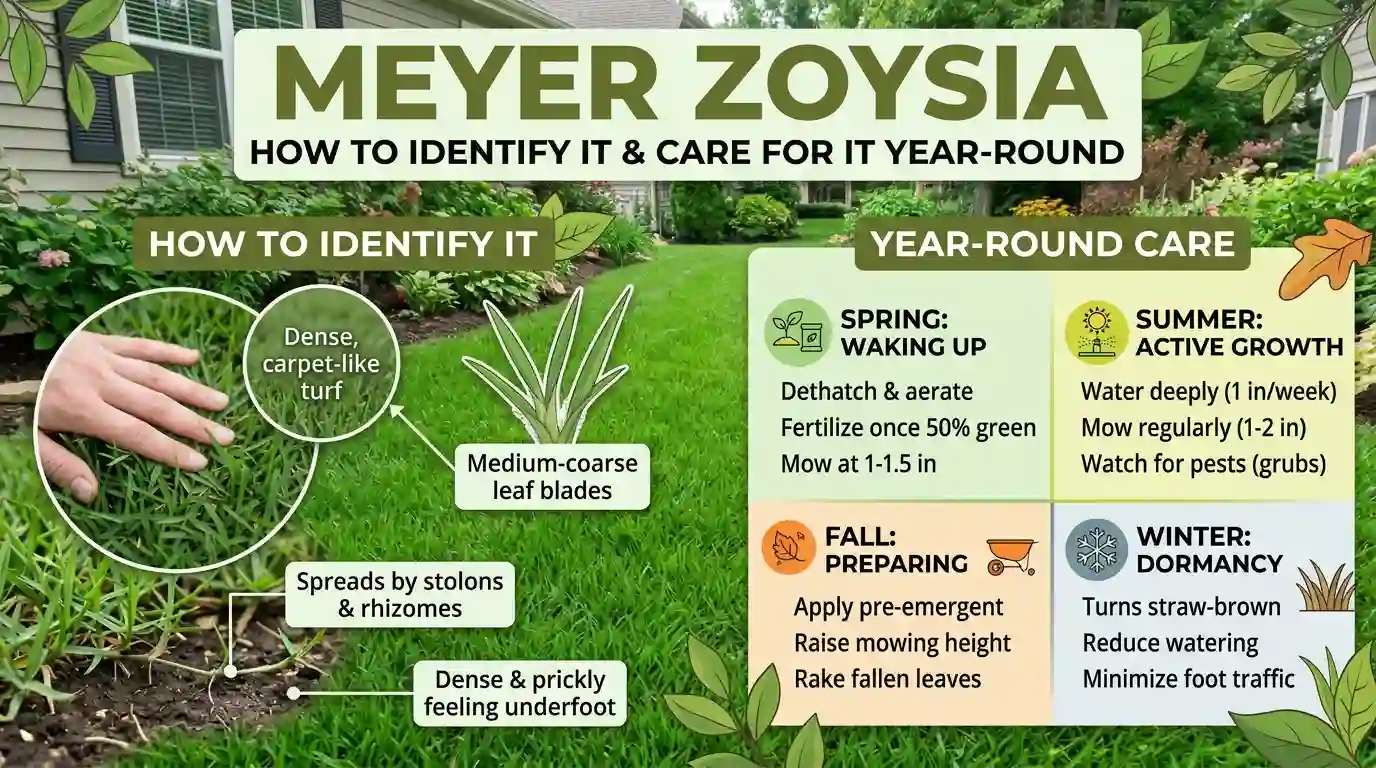
A thick, soft lawn that feels like a carpet under your feet is a joy to have. Meyer zoysia can give you that lawn. Meyer is tough. Its cold tolerance is excellent, and it crowds out many weeds. But you need to know what you have before you can care for it right. This guide shows you how to spot Meyer zoysia. Then it walks you through simple care steps for every season. The words are plain and the steps are short. Let’s start.
Quick Answer: Is It Meyer Zoysia?
You likely have Meyer zoysia if your lawn does these things:
In winter, Meyer turns tan or straw-colored. It greens up slowly in spring, though, and it feels thick and springy, like a rug. Its blades are medium width, a bit wider than a toothpick. It spreads by runners and forms a tight mat, not clumps. Want to be sure? Dig up a small plug about 2 inches wide. Look for runners on top of the soil and under it. Meyer has both. You will read more on this test below.
What Is Meyer Zoysia?
Meyer zoysia is a warm-season grass. Its full name is Zoysia japonica ‘Meyer’. That means it is a selected form of Japanese zoysia. It was bred to be tougher and neater than common zoysia, the older, plain type. Many people call it Z-52. You may also see it listed as Meyer 52 zoysia. These are all the same grass. Z-52 was its early selection name. Warm-season means it grows best when days are hot. It turns brown and rests when the weather gets cold. It wakes up again in spring. Meyer zoysiagrass is one of the most popular zoysia types in the United States. It does well in the transition zone. That is the middle part of the country. Summers there are too hot for many cool-season grasses. Winters there are too cold for many tender warm-season grasses. Meyer fits right in.
Lawn owners like Meyer for a few simple reasons:
- It forms a dense, thick lawn.
- Meyer handles cold better than most warm-season grasses, and it stands up well to foot traffic.
- It also needs less mowing than faster growers like Bermuda.
- Its roots run deep, so it handles dry spells well.
It also has downsides. It grows slowly. If your lawn gets damaged, it takes time to heal. Sod costs a lot. And it can build up thatch if you feed it too much. We will cover thatch later. When it is well kept, Meyer gives you a neat, fairway-like look, much like the grass on a golf course.
A Short History
Meyer zoysia was released in 1951. It was named after Frank Meyer, a plant explorer. He brought zoysia seeds to the United States from Asia in the early 1900s. Plant scientists then picked the best plants and made Meyer. Today it is a classic. Many older lawns across the country still use it. That says a lot about how tough it is.
Why Getting the Right ID Matters
You may wonder why this matters. Here is why. Each grass type needs its own mowing height, feeding plan, and weed products. If you treat Meyer like Bermuda or fescue, trouble follows. You may see thin grass, thick thatch, winter damage, and more weeds.
Most people who search for Meyer zoysia fall into one of three groups:
- Maybe you just bought a home and want to know what grass you inherited.
- Or you plan to install a new lawn and wonder if Meyer is a good fit.
- Perhaps there’s a problem, like yellow grass or bare spots, and you want to know the cause.
This guide helps all three.
How to Identify Meyer Zoysia

Many grasses look alike at first. If you are new to identifying zoysia grass, start with the signs below. Meyer has clear ones. The more signs you match, the more sure you can be.
Look at the Blade Width
Pick up a single blade and look at it closely. Meyer blades are medium width. They are about 3 to 4 millimeters wide. That is a bit wider than a toothpick. Across all zoysia types, blades can range from under 2 to about 5 millimeters.
They are thinner than tall fescue, which is closer to a matchstick. But they are not as thread-like as Emerald zoysia.
The tips are pointed. The blades feel stiff and firm. They stand up straight.
Check the Base of the Blade
Look closely where the blade meets the stem. You may see tiny, fine hairs there. This is a handy clue. It helps tell zoysia apart from many look-alike grasses. A small magnifying glass makes this easier.
Also watch a new blade as it grows. It starts out rolled up like a needle. Experts call this vernation. Then the blade flattens as it matures.
Check the Color
In summer, Meyer is a medium to deep green. It is a bit lighter than some other zoysia types. It looks even and full across the yard.
In fall, after the first frost, the grass fades. It turns a straw or tan color. This is normal. The grass is not gone. It is just resting.
Feel the Density
Run your hand across the lawn. A healthy Meyer lawn feels thick and springy. You should not see much bare soil. Walk on it barefoot. It should feel firm but soft at the same time.
Look for Runners
Zoysia spreads in two ways. Some runners grow above the soil. These are called stolons. Others grow just below the soil. These are called rhizomes.
Part the grass with your fingers and look near the ground. You will see tough, thin stems running sideways. Meyer has both kinds. This is how it fills bare spots over time.
Try the Plug Test
Cut a small plug of turf about 2 inches wide. Look at the base. You should see a tight web of stems, surface runners, and fine roots. This web is much denser than what you see in cool-season grasses like Kentucky bluegrass or ryegrass.
Still not sure? Take a clear photo of the lawn and the plug. Share it with your local extension office. They can confirm it for you. A garden center can help too. Some phone apps can also guess a grass type from a photo. Treat those as a first clue, not the final word.
Watch the Growth Speed
Meyer grows slowly. If you mow every week and the lawn barely seems to grow, that is a good sign. Fast growth points more toward grasses like Bermuda.
Check the Seed Heads
Zoysia makes small seed heads in late spring. They look like short, narrow spikes. They sit just above the grass. Meyer makes them, but you may not see many. Do not rely on this clue alone.
Meyer Zoysia vs. Look-Alike Grasses
Meyer often gets mixed up with other lawn grasses. Here is how to tell them apart.
Bermuda grass is the most common look-alike. Both go brown in winter. Both spread by runners. But Bermuda grows much faster. If you must mow every three or four days in summer, you likely have Bermuda. Bermuda also makes lots of seed heads. They give the lawn a fuzzy look. Meyer can go about seven days between mows. Meyer is also slower to green up in spring.
Tall fescue is a cool-season grass. It stays at least partly green in winter. It struggles in midsummer heat. Its blades are much wider. And it grows in clumps. Tug on a tuft. A fescue clump pulls apart. Meyer stays joined in a mat.
St. Augustinegrass has very wide, coarse blades. They can be 8 to 10 millimeters wide. The runners are thick and easy to see. Meyer feels much finer.
Centipedegrass has a light, apple-green color. It grows in a more open, loose way. Meyer is denser and darker.
Zoysia Comparison Chart
Now let’s compare Meyer with other zoysia types. Here is a quick chart.
| Type | Blade Feel | Cold Hardiness | Notes |
|---|---|---|---|
| Meyer (Z-52) | Medium, stiff | Best of the group | Sold as sod or plugs. Slow to grow in. |
| Emerald | Very fine, dark green | Lower | Looks neat but needs more care. |
| Zeon | Very fine, soft | Moderate | Great barefoot. Higher price. |
| Zenith | Medium | Good | Can be grown from seed. |
| Palisades | Wider blade | Moderate | Does well in shade. |
| Empire | Medium-wide | Moderate | Darker green. Fills in faster. |
| El Toro | Wider blade | Good | Grows and heals faster than Meyer. |
Let’s look at each one a little closer.
Meyer Zoysia vs. Zeon Zoysia
Zeon zoysia has very fine, silky blades. Underfoot, it feels great on bare feet, and it keeps good color all season. The trade-off is that it costs more than Meyer.
The trade-off is cold. Zeon is less cold-hardy than Meyer. In the upper transition zone, that can be risky. Meyer is coarser and stiffer, but it is the safer pick where winters bite.
Zeon is a Zoysia matrella type. So is Geo, another fine-bladed zoysia. These types usually feel softer than Meyer. They are often used on sports fields and high-end lawns.
Emerald Zoysia
Emerald zoysia has thin, wiry blades and a deep green color. It makes a very neat, cushiony lawn. It is a hybrid of Zoysia japonica and Zoysia tenuifolia. Meyer has wider blades and a lighter tone.
Emerald stays green a little later in fall. But it suffers winter damage more easily in cold areas. It also needs more mowing and more thatch care. If you live in the Deep South and want a fine-textured lawn, Emerald is worth a look.
Zenith Zoysia
Zenith zoysia is the one most people can buy as seed. That is its big selling point. It has medium blades and decent shade tolerance. If your lawn came from a seed bag, it may be Zenith, not Meyer.
Palisades Zoysia
Palisades zoysia has wider blades than Meyer. It is known for doing well in some shade. If your yard has more trees than sun, it is worth a look. It does not handle the cold quite as well as Meyer.
Empire, El Toro, and Innovation
Empire has medium-wide blades and a darker green color. It holds its color well and fills in faster than most zoysias. El Toro has wider blades and grows and heals faster than Meyer. Innovation is another wider-bladed type. All three trade some of Meyer’s density for speed.
Can You Grow Zoysia Grass From Seed?
Yes, but not every type. Zoysia grass seed is sold for some varieties, like Zenith. Seed costs less than sod. But it is slow. It can take two to three weeks or more to sprout. Then the young grass needs a full season or two to fill in.
Meyer is different. It is almost always sold as sod or plugs. Some growers also sell sprigs, which are bare pieces of runner. Seed sold as “zoysia” is rarely Meyer. If you see Meyer zoysia seeds for sale, be careful. Ask where they came from. Ask for proof of the variety. A fake label can leave you with a lawn that looks and acts very different.
If you do plant zoysia seed, follow these tips:
- Plant in late spring or early summer, when the soil is warm, around 70°F.
- Rake the soil smooth and press the seed in lightly.
- Keep the top layer of soil moist until the seed sprouts.
- Stay off the area until the grass is well rooted.
Where Meyer Zoysia Grows Best

Meyer grows well in USDA zones 6 through 10. Some guides stretch that to zone 11 for zoysia in general. It does best in the transition zone. Think of places like Kansas, Missouri, Virginia, Kentucky, Arkansas, and North Carolina. It is a popular pick in Little Rock and Kansas City, and across the Mid-Atlantic and the lower Midwest.
It also grows in the Southeast. You will see zoysia lawns in Georgia, Alabama, Louisiana, Mississippi, and South Carolina. It is common in newer neighborhoods, HOA communities, and golf-course-style subdivisions. Home builders often choose it for its premium look. In these hot, humid places, disease care matters most. We cover that below.
A tip: tips that work in coastal Georgia may not fit Kansas City. A mowing height or food rate that looks perfect in one place can cause trouble in another.
Cold Tolerance
Meyer handles cold well for a warm-season grass. A dormant lawn can survive temperatures near -10°F. But if winters often drop below 0°F, it can get winter injury. Repeated freezing and thawing can hurt it too.
Heavy foot traffic on frozen grass is a bad idea. It can break the crowns. You may see bare patches in spring.
Hot Places
Meyer loves heat. It grows best when days are between 80 and 95°F. In very hot, dry regions, it will need more water to stay green.
If you live in a hot country outside the United States, check with a local nursery first. Ask which zoysia types they can get. Ask if they sell sod, plugs, or seed. Supply can differ a lot from one region to another. Plan for deep watering in the hottest months. Water early in the morning to cut loss from the heat.
Cold Places
In very cold places, Meyer may struggle. It can stay tan for most of the year. If you live far north, ask a local lawn expert before you plant.
Spring Green-Up: What to Expect
Many new owners worry in spring. The neighbors’ lawns turn green. Yours stays tan. Relax. This is normal for Meyer.
Meyer starts to grow when the soil warms up. Most guides say the soil at 2 to 4 inches deep should reach about 60 to 70°F for several days. A cheap soil thermometer can tell you. In the transition zone, the lawn is often tan from about November until late April. Full color may not return until late May.
Bermuda usually greens up first. Meyer is slower. That slow start is one clue that you have Meyer.
Do not rush it with a heavy dose of food. Too much early feeding can cause trouble later in the season.
Is My Meyer Zoysia Dormant or Dead?
A tan lawn in spring scares many people. Is it asleep or gone? Here are two simple tests.
The tug test. Grab a handful of the tan grass and pull gently. Dormant grass stays firmly rooted. Its runners hold tight. Dead grass pulls up easily, like a loose carpet.
The runner test. Pick a tan runner and snap it open. Look inside the stem and at the crown, where the stem meets the roots. A living crown looks cream or light green. It feels firm. A dead crown looks brown. It feels mushy or dry and brittle.
Be patient before you decide. Wait until the soil has been warm for a few weeks, usually into late May. Meyer wakes up late. A patch that looks dead in April may green up in May.
If a patch is still tan after the rest of the lawn has turned green, check for winter injury or spring dead spot. You will find tips on both below.
Meyer Zoysia Shade Tolerance
Meyer likes full sun. It also tolerates light shade. It handles shade better than Bermuda. Most guides say it needs about 4 to 6 hours of direct sun a day for good density. A few say it can get by on 3 to 4 hours, but the lawn will be thinner.
If shade is heavy, the lawn thins out and gets sick more often. Under 3 hours of sun, zoysia struggles.
If your lawn sits under large trees, try these steps:
- Trim low branches to let in more light.
- Mow a little higher in shaded spots.
- Water less often, since shaded soil stays wet longer.
- Feed lightly. Shaded grass does not need as much food.
If shade is deep, a different grass or a ground cover may work better in that spot. Palisades zoysia handles shade better than Meyer.
Soil, Salt, and Tough Spots
Meyer adapts to many soil types. It likes soil that drains well. It can grow in clay if the water does not pool. Heavy, soggy soil is a problem. Sandy soil works too, but it needs more frequent feeding because nutrients wash out fast.
Zoysia handles some salt better than many lawn grasses. That helps in coastal areas, near roads, or where the water has some salt in it. Meyer has a moderate level of tolerance. Heavy salt will still hurt it. If your water is salty, water deeply now and then. This helps flush salt below the roots. A soil test can show if salt is a problem.
Packed soil is a common issue. If a screwdriver will not slide into the soil, aerate the lawn. This lets air and water reach the roots.
How to Plant Meyer Zoysia
Planting is the hard part. After that, care is easy. Take your time.
Pick the Right Time
Plant in late spring or early summer. The soil should be warm, around 70°F. Warm soil helps roots grow fast. Do not plant in late fall. The grass will not have time to settle in before winter.
Prepare the Soil
Clear away old grass, rocks, and weeds. Loosen the top few inches of soil. Mix in some compost if your soil is poor.
Zoysia likes soil that drains well. It does not like standing water. If your yard stays soggy, fix the drainage first.
A soil test is a smart move. It tells you the pH and what nutrients are missing. Meyer does best with a pH between 6.0 and 6.5. Some guides allow up to 7.0. If the pH is off, lime raises it and sulfur lowers it. Follow the test results.
Choose Sod or Plugs
Sod gives you a lawn right away. It costs more. Plugs are small pieces of grass. You plant them 6 to 12 inches apart, and they spread. They cost less but take longer. Plan on two to three growing seasons for plugs to fill in.
What Does Meyer Zoysia Cost?
Prices change by region, season, and seller. So ask for a quote per square foot before you buy. Here is how the options compare:
- Sod costs the most. You get a finished lawn fast. You also pay for delivery and for the labor to lay it.
- Plugs cost less up front. But you wait much longer for the lawn to fill in. You also need to keep weeds out during that time.
- Seed costs the least. But real Meyer is rarely sold as seed. Other types, like Zenith, are.
Do the math on your whole lawn. Measure the length and width of each area. Multiply them. Add them up. Then add about 5 to 10 percent for cuts and waste if you are buying sod. Compare quotes from two or three local sellers.
Remember that Meyer saves money over time. It needs fewer mows than faster grasses like Bermuda. It also needs less food and water than some. That helps offset the higher starting price.
Water Well After Planting
Water the new grass every day for the first two weeks. Keep the soil moist, but do not drown it. Then water less often, but a little deeper. By week four, treat it like a normal lawn.
Stay off the new grass as much as you can. Let the roots take hold.
Zoysia Grass Maintenance: The Basics
Good zoysia grass maintenance comes down to a few simple habits. Meyer follows the same rules. Mow at the right height. Water deeply. Feed lightly. Keep thatch in check. The sections below cover each one.
Mow Low, But Not Too Low
Keep Meyer between 1 and 2 inches tall. That is shorter than many grasses. A short cut keeps the lawn dense and helps stop thatch.
Each zoysia type likes a slightly different height. Here is a quick guide:
| Zoysia Type | Mowing Height |
|---|---|
| Emerald and Zeon | 0.5 to 1 inch |
| Meyer, Empire, and Zenith | 1 to 1.5 inches (up to 2 is fine for Meyer) |
| El Toro and Innovation | 1.5 to 2 inches |
Reel Mower or Rotary Mower?
The type of mower changes how low you can go.
| Reel Mower | Rotary Mower | |
|---|---|---|
| Best height for Meyer | About 0.75 to 1.5 inches | About 1.25 to 2 inches |
| Cut quality | Cleanest cut, like scissors | Good cut if the blade is sharp |
| Upkeep | Needs frequent mowing and tuned blades | Easier to find and fix |
| Cost | Often higher for power models | Common and lower in price |
| Best for | A tight, fairway look | Most home lawns |
For most homes, a sharp rotary mower at 1.25 to 1.75 inches works well. If you love a golf-course look and do not mind mowing often, a reel mower is worth a try.
Follow the One-Third Rule
Never cut off more than one-third of the blade at once. If you keep the lawn at 1.5 inches, mow when it reaches about 2.25 inches.
If the grass gets too tall, do not chop it all at once. Lower it in steps over a few mows. Cutting too much at once is called scalping. It stresses the grass, turns it pale, and can take weeks to heal.
Keep Blades Sharp
Dull blades tear the grass. Torn tips look gray and brown. Zoysia is tough, and it wears down mower blades fast. Sharpen your blade a few times each season.
Skip Wet Grass
Do not mow when the lawn is wet. Zoysia is so dense that wet clippings clog the mower. The cut also comes out ragged. Wait for the grass to dry.
How Often to Mow
In peak summer, many lawns need a mow every five to seven days. Some guides say every 10 to 14 days is enough if growth is slow. Watch your lawn, not the calendar. Mow when it reaches one-third above your target height.
In spring and fall, you can mow less. Keep mowing as long as the grass keeps growing. Stop when it goes dormant.
Leave the Clippings
If you mow often, leave the clippings on the lawn. They break down and feed the soil. This can cut your need for fertilizer by up to a quarter. If you see clumps, spread them out or bag them so they do not smother the grass.
Edge and Change Your Pattern
Edge along walks and beds to keep the lawn neat. Switch your mowing direction each time. This keeps the grass standing straight and keeps ruts from forming.
Watering Tips
Meyer handles dry weather better than many grasses. Its roots can reach more than two feet deep. It is moderately drought tolerant. But it still needs water to look its best.
How Much Water
Give it about 1 inch of water each week. That includes rain. Guides range from half an inch to 1.25 inches, so start at 1 inch and adjust. In very hot weather, you may need a bit more.
Try the can test. Set a few small cans on the lawn while your sprinkler runs. See how long it takes to fill them to 1 inch. Now you know your run time.
Water Deep, Not Often
Water once or twice a week for a long time. A common plan is two sessions a week of about half an inch each. Do not give a little every day. Deep watering pushes roots down. Deep roots make the grass strong in a dry spell. On sandy soil, split the water into two sessions a week. Clay soil can often take one deep soak.
Use the screwdriver test. Push a screwdriver into the soil after you water. It should slide in easily 4 to 6 inches. If it will not go in that far, the soil is too dry.
Water in the Morning
Early morning is best, between about 4 and 10 AM. The sun dries the blades, and less water is lost to the heat. Night watering leaves the grass wet too long. That can invite lawn disease.
Know the Signs of Thirst
Thirsty zoysia looks gray-green or bluish. The blades fold or curl and look like pine needles. Footprints stay in the grass long after you walk on it. If you see these signs, water within a day or two.
Here is a catch. Zoysia can stay green for a while in dry weather before it shows stress. That can fool you into watering too little. Footprints are the most reliable sign. Check for them often.
When Drought Turns the Lawn Brown
In a long, hot dry spell, Meyer may go dormant to save itself. The lawn turns tan, even in summer. This is a survival move. The crowns are still alive.
You have two choices. You can let it rest. Or you can give it a deep soak to bring the green back. If you let it rest, do not let it dry out fully. A light watering every few weeks keeps the crowns alive. Once the weather cools or the rain returns, the lawn usually bounces back in a few weeks.
Try to avoid cycling in and out of dormancy again and again. It uses up the plant’s energy. Steady, deep watering is better.
Rest in Fall and Winter
When the grass starts to go dormant, cut back on water. It needs much less in cool weather. But do not let the soil dry out fully, even in winter. A light drink in a long dry spell helps.
What Is the Best Fertilizer for Zoysia Grass?

This is one of the most common questions. The short answer: pick a slow-release lawn food made for warm-season grasses. Then use it in small amounts.
Here is what to look for:
- Slow-release nitrogen. It feeds the grass over several weeks. It lowers the chance of burn and gives steadier growth. Some foods are timed to release with soil temperature, which is a smart option.
- A warm-season label. These foods are made for grasses like zoysia, Bermuda, and centipede.
- Organic options. Some owners like organic foods. They feed the soil and can help break down thatch.
- Micronutrients. If a soil test shows low iron or other trace minerals, add them. Healthy soil life helps the grass too.
- A soil test first. It tells you if you need extra phosphorus or potassium. Many lawns already have enough phosphorus.
Skip foods with very high nitrogen. Meyer is easier to overfeed than underfeed. Too much food causes thick thatch, weak grass, and disease.
How Much to Use
Many university extension programs suggest 1 to 2 pounds of nitrogen per 1,000 square feet each year. NC State Extension says many lawns do fine on 1 or 2 pounds a year. Texas A&M AgriLife Extension says improved zoysia types usually need less nitrogen than Bermuda, and lists a range of about 2 to 4 pounds a year. Some other guides go up to 4. Start low. You can always add more if the lawn looks pale.
Slower types like Emerald need less. Faster types like Empire and El Toro can take more.
Split the total into small feedings. Never put down more than about three-quarters to 1 pound of nitrogen at once.
A Simple Feeding Calendar
Here is a plan based on common advice for the transition zone:
- Late spring (early to mid-May): Wait until the lawn is mostly green. Use a balanced food like 12-12-12. Or use an organic product.
- Early summer (early to mid-July): Use a food with more nitrogen, like 24-3-8. Slow-release is best.
- Late summer (mid-August to early September): Use a balanced food. In cooler areas, skip this one. Late feeding can hurt the grass before winter.
In the warmer Southeast, many lawn programs start in late April and run three feedings through September. They stop by mid-September. After that, no food.
If you want to keep the color up between feedings, add a light half-rate dose. Only do this if you are not happy with the color.
Skip feeding in fall and winter. The grass will not use it, and rain can wash it away. It can also help cool-season weeds. Late feeding also raises the risk of large patch disease. More on that below.
Want Deeper Green Without Fast Growth?
Sometimes the lawn looks pale, but you do not want a burst of new growth. That would mean more mowing and more thatch. Try an iron product instead. Iron gives a quick color boost without pushing top growth. Slow-release organic foods with iron also work well.
Before you reach for the bag, check the basics. Pale grass can come from thirst, soggy soil, dull mower blades, or a soil pH that is off. A soil test will tell you if it is a food problem or something else.
Do the Math
Fertilizer bags show three numbers. The first is nitrogen. Say you have a 25-0-10 bag. You want to put down half a pound of nitrogen per 1,000 square feet. Half a pound is 25 percent of 2 pounds. So spread 2 pounds of product per 1,000 square feet.
Spread It Right
Use a rotary spreader. Set it to half rate. Make two passes in different directions. This avoids streaks. Water the lawn lightly right after. This moves the food into the soil and keeps the blades from burning.
Handling Thatch
Thatch is a layer of dead stems and roots. It sits between the green grass and the soil. A little thatch is fine. A layer under half an inch can even act as cushion.
Zoysia makes more thatch than most warm-season grasses. If it grows thicker than about three-quarters of an inch, it is time to act. Too much thatch blocks water, causes shallow roots, and invites disease.
Signs of Too Much Thatch
- The lawn feels spongy.
- Water runs off instead of soaking in.
- The grass looks weak even when you water.
- Your mower seems to sink into the lawn.
To check, cut a small wedge of turf. Measure the brown, fibrous layer. Check once a year.
How to Fix It
Use a power rake or a vertical mower, also called a dethatching machine. Do this in late spring or early summer, after the grass is fully green. It has the whole warm season to heal. Do not dethatch in fall or when the grass is stressed. The lawn will look rough for a bit. That is normal. Collect the debris. Then water and add a light feeding, no more than half a pound of nitrogen.
Core aeration helps too. It pulls small plugs of soil out of the lawn. This lets air, water, and food reach the roots. Aerate once a year in early summer.
Some lawn pros also offer liquid aeration. It uses a spray to loosen soil and help break down thatch at the root level. It has no mess and less recovery time. Ask a local lawn pro if it is offered in your area.
The best fix is to prevent it. Cut back on nitrogen. Do not overwater. Some owners switch to organic food, which helps break down thatch.
Leveling a Bumpy Lawn
Zoysia can get lumpy over time. Thatch, old ruts, and settled soil all play a part. A smooth lawn is easier to mow and looks better.
Topdressing is the easy fix. Spread a thin layer of sand, soil, or a sand and soil mix over the low spots. Aim for about a quarter to half an inch at a time. Rake it in so the grass tips still show. Do this in late spring or early summer, when the grass is growing fast. It will grow up through the new layer. If a low spot is deep, repeat the process a few weeks later instead of piling it on at once.
You can pair topdressing with core aeration. The holes help the mix settle in. Compost also works and helps break down thatch.
Weed Control
Healthy Meyer is thick. Thick grass leaves little room for weeds. That is your best defense.
Use a Pre-Emergent in Spring and Late Summer
A pre-emergent product stops weed seeds from sprouting. Put it down in early spring, when the soil warms to about 55°F. For many lawns, that is around mid-April. Nature gives a clue too. When forsythia shrubs bloom, the soil is often near that mark. Skip fertilizer in the same pass. Read the label to be sure it is safe for zoysia. Do not use it on new sod or plugs until they have rooted well.
In the Southeast, many lawns get a first pass in late winter, around February or early March. Then they get a second pass in spring.
A second round in late summer helps too. It stops winter annual weeds, like chickweed and henbit, before they start.
Spot-Treat Weeds That Show Up
For weeds that slip through, use a product made for zoysia lawns. Always read the label first and follow your local rules. Some products can harm zoysia.
Many broadleaf weed products are safe on zoysia when used as directed. Some three-way mixes contain 2,4-D, MCPP, and dicamba. Check that the label lists zoysia. Apply them when it is below about 85°F. Avoid windy days so the spray does not drift. Spray only the weeds, not the whole lawn. Granular products work best when the grass is damp with dew.
Grassy weeds are harder. They often need a different product from broadleaf weeds. Timing matters most.
Pulling weeds by hand also works well, especially in small lawns. Do it after rain, when the soil is soft.
Read the Clues
Weeds tell you what is wrong. Crabgrass and goosegrass show up in thin, sunny spots. Nutsedge points to wet or packed soil. Chickweed and henbit pop up when the lawn is dormant and open. The fix is the same: grow a thicker lawn.
Common Problems and Fixes
Meyer is fairly tough. But it can still have trouble.
Yellow or Pale Grass
Yellow grass has a few common causes:
- Low food. If the whole lawn looks pale and slow, it may need food. A light feeding of half a pound of nitrogen often fixes it in two to three weeks.
- Too much water. Yellow patches in low spots often mean soggy soil. Dig down 4 to 6 inches and check. Cut back on water and fix drainage.
- Cold damage or disease. In spring, patches that stay tan while the rest turns green may be winter injury or spring dead spot.
Large Patch
Large patch is the top disease for zoysia, especially in the Southeast. The fungus behind it is Rhizoctonia solani. It is the same fungus that causes brown patch in cool-season grasses. On zoysia, it shows up as round or uneven orange-brown rings. They can be a foot across or many feet.
When does it strike? Mostly in fall, from October through November. It also shows up in spring, from March through April. Cool nights, warm days, and high humidity set it off.
What makes it worse?
- Feeding too late in the season
- Too much water, or watering at night
- Poor drainage
- Thick thatch
- Mowing too low
- Poor air flow
How to help prevent it:
- Stop feeding nitrogen by mid-September.
- Water in the early morning.
- Fix low, soggy spots.
- Keep thatch in check.
- Do not mow too low.
If your lawn has a history of large patch, ask a local lawn pro or extension office about a preventive fungicide. The best windows are fall and early spring. Follow the label. Once the disease is active, a treatment can shorten the outbreak. But zoysia heals slowly. Recovery can take months. Prevention beats the cure.
Spring Dead Spot
You will see round, sunken patches with clear edges. They show up when the lawn greens up. Probe the crowns. If they are mushy or dry with no green tissue, that grass will not come back. Fill the area with plugs or let runners spread in. To prevent it, avoid late-season nitrogen. A fall feeding with potassium and low nitrogen can help.
Zoysia Patch
This shows up in early spring. Keep thatch low. Do not feed in cool weather.
Dollar Spot
This disease makes small, straw-colored spots about the size of a silver dollar. It often shows up when the lawn lacks nitrogen. A proper feeding plan usually helps.
Rust
Rust leaves orange dust on your shoes and mower. It shows up when the grass grows slowly. Feed the lawn lightly, and it often fades on its own.
Grubs
White grubs feed on roots. You will see irregular brown patches that pull up like a carpet. Thin spots are most at risk. Cut and peel back a one-square-foot area at the edge. Count the grubs. More than about 10 per square foot means treatment may be needed. Many lawn guides time grub control for mid-June to mid-July. Follow the label.
Billbugs
These small bugs lay eggs in the grass. The young bugs eat the stems and roots. You may see small, uneven dead patches in summer. The grass pulls up easily. The stems look hollow. A local lawn expert can tell you the best time to treat.
Chinch Bugs
These tiny bugs suck sap from the blades. They like hot, sunny spots near pavement. They are less common on zoysia than on Bermuda. But they can still cause yellow, dying patches. The damage looks like drought, but water does not help. Try the coffee can test. Push a can with both ends open into the soil. Fill it with water. Watch for small bugs to float up.
Sod Webworms
These small worms chew the blades, mostly during dry spells. You may see ragged, chewed grass and small brown spots. Birds pecking at the lawn can be a clue. Treat only if the damage is clear. Read the label first.
Nematodes
These are tiny worms in the soil. They feed on roots and weaken the grass. A soil lab test can confirm them.
How to Fix Bare Spots
Bare spots happen. Shade, traffic, packed soil, or past trouble can cause them. First, find the cause. Then pick a fix.
Small spots (up to 6 to 8 inches): Let the runners fill them in. This takes about 4 to 8 weeks of good growing weather. Keep the soil loose and the weeds out.
Larger spots: Use plugs. Cut 2-inch plugs from a healthy part of the lawn. Or buy trays. Plant them 6 to 12 inches apart. Keep the top few inches of soil moist for 2 to 3 weeks. Then switch to deep, less frequent watering. It may take a full season to fill in.
Very large spots: Lay new sod.
If traffic wears a path, add stepping stones. If the soil is packed, aerate.
How Long Does Recovery Take?
With good care, Meyer usually shows recovery in 3 to 6 weeks of good growing weather. If you see no change after about 8 weeks of warm weather and steady moisture, test the soil. You may need to plug or replace the worst areas.
Meyer Zoysia for Pets and Kids

A lawn is for living on. Meyer holds up well to play, running, and paws. Its dense mat and deep runners help it bounce back from wear. That makes it a good pick for families.
But be honest about the load. Zoysia heals slowly. If kids and dogs run on it every day, wear will show. Light to medium use is fine. Heavy daily use is not.
Tips for Homes With Pets
- Dog spots. Pet urine is high in nitrogen. It can leave yellow or brown spots. Rinse the area with water soon after. This dilutes it.
- Pick a potty area. Train your dog to use one part of the yard. It keeps damage in one place.
- Water deeply. A well-watered lawn handles spots better.
- Fix the spots. Rake out the dead grass. Add a little soil. Let nearby runners fill in, or add a plug.
Tips for Homes With Kids
- Let new grass root. Keep play off new sod or plugs for several weeks.
- Rest it in winter. Frozen dormant grass breaks easily. Move play to a different area if you can.
- Watch worn paths. If a spot gets heavy use, rotate where the goal or swing sits.
Lawn Care and Safety
Read every product label. Keep kids and pets off the lawn after you treat it. Follow the label on how long to wait. Store all lawn products in a closed, safe place.
Should You Overseed in Winter?
Some owners in warm areas overseed dormant Meyer with perennial ryegrass. It keeps the lawn green in winter. But there are downsides. Ryegrass competes with zoysia in spring. It can delay green-up. It also adds mowing and feeding in cool months. Over time, it can thin the zoysia. Weigh the look against the extra work.
Is Zoysia Right for Your Lawn?
Be honest about your yard. Meyer is a premium grass. It rewards owners who care for it.
Meyer is a good fit if:
- You want a dense, soft lawn.
- Your yard gets full sun or light shade.
- Your soil drains well.
- You can handle some disease prevention.
- You do not have heavy daily traffic.
Meyer may not be the right pick if:
- Your yard is in deep shade.
- Kids and dogs run on it every day.
- You want fast recovery from damage.
- Your soil stays soggy.
If it is a fit, you will have one of the best-looking lawns on the street.
A Simple Year-Round Calendar
Here is an easy plan to follow.
Late Winter
- Put down the first pre-emergent in warmer regions.
- Watch for early signs of large patch when temperatures swing.
Early Spring
- Rake off leaves and debris gently.
- Put down pre-emergent for weeds.
- Clean and sharpen your mower.
- Do a soil test.
Late Spring
- Wait for full green-up.
- Give the first feeding.
- Dethatch if needed.
- Start regular mowing.
Early Summer
- Aerate the lawn.
- Topdress low spots.
- Give the second feeding.
- Water deeply once or twice a week.
Mid-Summer
- Mow as needed, often every five to seven days.
- Watch for signs of thirst.
- Check for bugs and spots.
- Disease risk is lower in peak heat.
Late Summer
- Stop feeding in cooler areas.
- Put down pre-emergent for winter weeds.
- Start watching for early signs of large patch.
- Keep up with watering in dry weather.
Fall
- Do not feed. Large patch risk is highest.
- Water in the morning and fix soggy spots.
- Cut back on watering.
- Rake leaves off the grass.
- Mow until the grass stops growing.
- Take a soil test if you have not done one in a few years.
Winter
- Let the grass rest.
- Stay off frozen grass.
- Keep heavy items off the lawn.
- Plan next year’s care.
Print-Friendly Checklist
Want to keep this guide close? Copy the list below into a note or save this page as a PDF. Then print it and hang it in your garage or shed.
Meyer Zoysia Identification Checklist
- Medium blades, about 3 to 4 mm wide
- Fine hairs at the blade base
- Tan or straw color in winter
- Slow green-up in spring
- Thick, springy feel
- Runners above and below the soil
- Slow growth
Meyer Zoysia Care Checklist
- Mow at 1 to 2 inches
- Never cut more than one-third
- Water about 1 inch a week, deeply, in the morning
- Feed in small amounts, late spring to summer
- No feeding in fall or winter
- Check thatch once a year
- Aerate in early summer
- Pre-emergent in early spring
Pros and Cons of Meyer Zoysia
Pros
- Dense, rich look
- Good cold tolerance
- Handles foot traffic
- Fewer mows than Bermuda
- Deep roots for dry spells
- Handles light shade and some salt
Cons
- Slow to grow in
- Sod costs a lot
- Builds thatch if overfed
- Slow spring green-up
- Prone to large patch in humid areas
- Slow to heal from wear
Where Guides Disagree
You will find different numbers on different sites. That is normal. Mowing times, sun hours, and food amounts vary by climate and soil. A lawn in Georgia has different needs than one in Kansas. Use the ranges in this guide as a start. Then check with your local extension office for advice that fits your area. This matters most for feeding times and disease care.
Common Mistakes to Avoid
Even good lawn owners slip up. Watch out for these.
- Treating it like Bermuda. Zoysia grows slower, heals slower, and needs different care.
- Mowing too high or too low. Meyer likes 1 to 2 inches. Scalping hurts it.
- Too much fertilizer. More is not better. It leads to thatch and disease.
- Feeding too early in spring or too late in fall. Late feeding invites large patch.
- Watering a little every day. This keeps roots shallow.
- Watering at night. Wet blades overnight invite disease.
- Planting at the wrong time. Cool soil slows rooting.
- Ignoring dull blades. Torn grass looks bad and gets sick more often.
- Using the wrong weed product. Always check that it is safe for zoysia.
- Guessing the grass type. Confirm what you have before you buy products.
- Calling it dead too soon. A tan lawn in April may just be asleep.
- Expecting fast results. Meyer is slow. Give it time.
Frequently Asked Questions
Yes. They are two names for the same grass. You may also see it called Meyer 52 zoysia.
It is rare. Most Meyer is sold as sod or plugs. Seed sold under the Meyer name is often not the real thing.
Zenith is one of the best-known zoysia types sold as seed. Check the label and the seller before you buy.
It depends on where you live and how you buy it. Sod costs the most, plugs cost less, and seed costs the least. Ask for quotes per square foot from local sellers.
In fall and winter, this is normal. The grass is dormant. In summer, brown grass often means too little water, too much thatch, or a lawn problem.
Tug on it. Dormant grass stays rooted, and the crowns look cream or light green inside. Dead grass pulls up easily, and the crowns are brown and mushy or dry. Wait until late spring before you decide.
This is often large patch disease. It shows up in fall and spring when nights are cool and the air is humid. Water in the morning, stop feeding by mid-September, and fix soggy spots.
Meyer grows as a mat with runners. Tall fescue grows in clumps and has much wider blades. Fescue also stays partly green in winter.
Bermuda grows much faster and makes more seed heads. Meyer grows slowly and greens up later in spring.
Every five to seven days during peak growth. Some lawns can wait longer. Mow less often in spring and fall.
Between 1 and 2 inches is a good range.
It handles light shade and does better than Bermuda. In deep shade, though, it does not do well, and it needs about 4 to 6 hours of sun.
It has moderate tolerance. That is better than many lawn grasses, but heavy salt will still hurt it.
Yes, with limits. It handles play, but it heals slowly. Rinse urine spots with water soon after, and give your dog one potty area.
Slowly. A plug lawn can take two to three seasons to fill in.
A slow-release lawn food made for warm-season grass works well. Follow the label and a soil test.
Try an iron product or a slow-release organic food with iron. Also check water, mower blades, and soil pH.
Topdress low spots with a thin layer of sand or soil mix, about a quarter to half an inch at a time. Do it in late spring or early summer.
Cut back as the grass goes dormant in fall. It needs very little water in winter, but do not let the soil dry out fully.
Meyer has wider, stiffer blades and handles cold better. Emerald has finer blades and a darker color but is less cold-hardy.
Zeon feels softer and has finer blades. Meyer handles cold better and costs less. The best pick depends on your climate.
Yes. It is a popular pick there because it handles cold winters well. It is rated for zones 6 through 10.
It loves heat. It needs deep watering in very dry places. Check with a local nursery to see which zoysia types they can supply.
Final Thoughts
Meyer zoysia is a classic for a reason. It is tough, dense, and handles cold better than most warm-season grasses. Once you know how to spot it, care gets simple. Look at the blade, the color, the base hairs, and the runners. Mow low. Water deeply. Feed in small amounts. Fix thatch before it gets thick. Watch for large patch in fall and spring. Check with your local extension office when guides disagree. And be patient. Do these things, and your lawn will reward you. Soon you will have a thick, green carpet that you can enjoy for years.

Jessica Morgan writes easy-to-understand guides about grass varieties, lawn care, growing conditions, and seasonal lawn maintenance. She focuses on practical information that helps readers identify different grasses, understand their needs, and make better choices for healthy lawns.