


Many people feel the same way. Most get a lawn with the house, but nobody hands over a label. So you mow, water, and hope for the best.
Here is the good news. You can find out. It takes a photo, a few clues, and a little time. This guide shows you how. It is plain and simple. You do not need to be an expert.
Why Knowing Your Grass Type Matters
Every grass has its own needs. One grass likes a short cut. Another gets hurt by it. One loves heat. Another gives up in July.
When you know your grass, you can:
- Mow at the right height
- Water at the right times
- Pick the right weed control product
- Buy the right seed for bare spots
- Feed the lawn when it is ready to grow
A name is like a map. Without it, you guess. With it, you know what to do next.
Method 1: Use a Free Grass Identifier or Photo Tool
The fastest way to answer “what grass is this?” is a photo. A free grass identifier looks at your picture and suggests a match. It often takes just seconds. Many tools need no app and no sign-up. Maybe you already have a picture and ask, what grass is this picture showing? Upload it and let the tool make a first guess.
Good photos give good answers. Here is how to take one.
- Get close. Fill the frame with a few blades. A photo from standing height will not work.
- Use daylight. Skip the flash. Shade and late evening change how colors look.
- Show the seed head. If the grass has one, include it. It is often the best clue.
- Pick one type of grass. Do not photograph a patch where two kinds mix.
- Skip freshly mowed grass. Longer blades show more detail.
- Add a size clue. Lay a ruler or a coin next to the blades.
- Write down the date. Grass looks different in each season. Also note where it grows, such as a lawn, a garden bed, a meadow, or a crack in the pavement.
- Take a few angles. One close-up and one wider shot is a good start.
Web Tool or Phone App?
You can use a website or a phone app. Both do the same job. A web tool opens in your browser. There is nothing to install. It works on a phone, a tablet, or a computer. A grass identifier app lives on your phone. It is handy when you stand in the yard. Looking for an app that answers “what grass is this?” Many people search for a free app to identify grass type, and free versions often work well. Some limit how many photos you can scan each day. Either way, the AI scan works the same. It compares your photo with many known grasses. Then it suggests the closest match.
What a Good Photo Looks Like
Picture two photos. In the first, blades fill the whole frame. You can see the width, the tip, and the color. The light is soft and clear. That is a good photo.
In the second, the lawn is far away. It is blurry. Half of it sits in shade. That one will not help. You will get a weak answer, or none at all.
How to Read Your Result
Most tools give a confidence score. A high score means the tool feels sure. A low score means it is unsure. Treat a low score as a hint, not a fact.
Sometimes you get a group name, called a genus, instead of one exact species. That is fine. It is honest. A broad answer is better than a wrong one.
Many tools show photos of the match, so you can compare side by side. Check the match against the clues in this guide. If they agree, you can trust it. Try two or three tools. If they all agree, even better.
One more thing. Look at what the tool does with your photos. A good tool has a short, plain privacy note. It tells you how long your pictures stay on its servers.
Method 2: Identify Grass by Eye
No phone handy? Use your eyes. Start with one big question. Is your grass warm-season or cool-season?
- Warm-season grasses love heat. They grow fast in summer. They turn tan in winter. You find them in the south and in hot places around the world. In the United States, think Texas, Florida, Georgia, and the Carolinas.
- Cool-season grasses like mild weather. They grow best in spring and fall. They stay green in the cold. You find them in the north. In the United States, think the Midwest and the Northeast.
Your climate is a big clue. Some places sit in the middle. Both types can grow there. That makes the job harder, so look for more clues. Below are 10 types of grass found on most lawns, plus kikuyugrass, a regional favorite.
Common Warm-Season Grasses

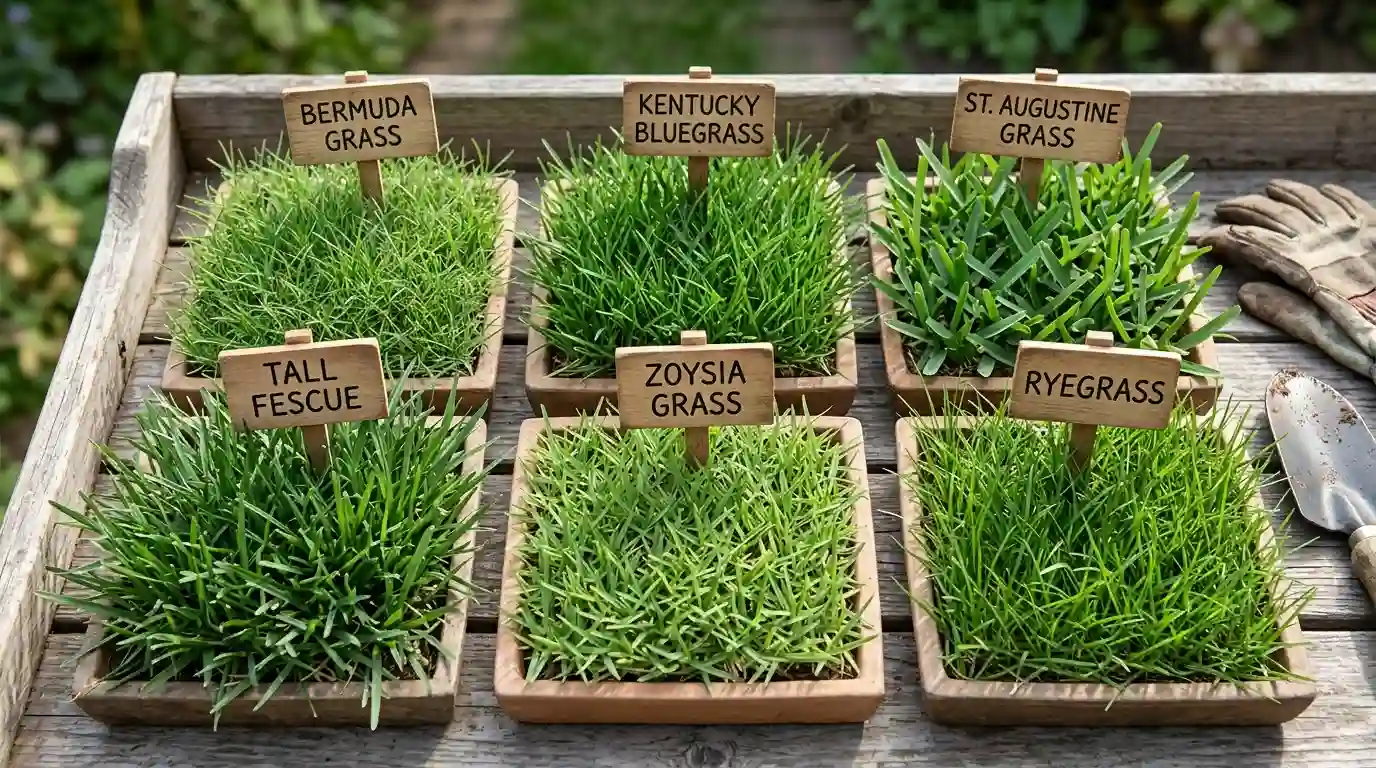
- Bermudagrass: Fine to medium blades. Thick and low. It spreads by runners above and below the ground. It loves full sun and handles foot traffic well.
- St. Augustinegrass: Wide, coarse blades with rounded tips. The stems are thick and creep along the ground. It likes warm, humid air and can take some shade.
- Zoysiagrass: Dense, like a carpet. The blades are stiff. It feels firm under your feet. It spreads slowly.
- Centipedegrass: Light green and low. The blades are flat. It grows slowly and likes soil that is a little acidic. It needs little care.
- Bahiagrass: Tough and coarse. It handles dry spells well. Look for tall seed stalks with two forks, shaped like a V. It does well in sandy soil.
- Buffalograss: Soft, curly, gray-green blades. It stays short. It needs very little water. It comes from the Great Plains and suits dry, sunny yards.
- Kikuyugrass: Bright green, with fast runners that cover ground quickly. You see it often in Australia, South Africa, and coastal California.
Common Cool-Season Grasses
- Kentucky bluegrass: Rich green and soft. The tip looks like the front of a boat. Look for two faint lines down the middle of the blade, like train tracks. It spreads by underground stems and fills gaps well.
- Tall fescue: Wide, coarse blades that grow in clumps. It handles heat and dry weather better than most cool-season grasses.
- Fine fescue: Very thin blades, almost like needles. It does well in shade and poor soil.
- Perennial ryegrass: Shiny blades with a clear ridge on top. It sprouts fast. People use it to fill thin spots quickly.
Side-by-Side Grass Identification Chart
| Grass | Season | Blade | Typical mowing height |
|---|---|---|---|
| Bermudagrass | Warm | Fine to medium, pointed | 1–2 in |
| Zoysiagrass | Warm | Stiff, narrow to medium | 1–2.5 in |
| St. Augustinegrass | Warm | Wide, flat, rounded tip | 3–4 in |
| Centipedegrass | Warm | Flat, light green | 1.5–2 in |
| Bahiagrass | Warm | Coarse and tough | 3–4 in |
| Buffalograss | Warm | Curly, gray-green | 2–3 in |
| Kikuyugrass | Warm | Bright green, fast runners | 1–2 in |
| Kentucky bluegrass | Cool | Soft, boat-shaped tip | 2.5–3.5 in |
| Tall fescue | Cool | Wide, coarse clumps | 3–4 in |
| Fine fescue | Cool | Very thin | 2–3 in |
| Perennial ryegrass | Cool | Shiny, with a ridge | 2–3 in |
Heights are typical. Check a local guide for your area. Want photos too? Local garden centers and lawn guides show different types of grass with pictures and names. Keep one open beside this chart.
Common Names and Scientific Names
Every plant has two kinds of names. The common name is easy to say. The scientific name is exact. It has two words. The first is the genus. The second is the species. Two grasses can share a nickname, but each has only one scientific name.
| Common name | Scientific name |
|---|---|
| Bermudagrass | Cynodon dactylon |
| Zoysiagrass | Zoysia japonica |
| St. Augustinegrass | Stenotaphrum secundatum |
| Centipedegrass | Eremochloa ophiuroides |
| Bahiagrass | Paspalum notatum |
| Buffalograss | Bouteloua dactyloides |
| Kikuyugrass | Cenchrus clandestinus |
| Kentucky bluegrass | Poa pratensis |
| Tall fescue | Festuca arundinacea |
| Fine fescue (creeping red fescue) | Festuca rubra |
| Perennial ryegrass | Lolium perenne |
You do not need to memorize these. They help when you search for more detail or talk to an expert.
A Quick Checklist for Telling Grasses Apart
Asking what type of grass is this? Look at a small patch of your lawn. Then answer these questions:
- Blade width: Thin like a needle, medium, or wide and coarse?
- Blade tip: Pointed, rounded, or shaped like a boat?
- Growth habit: Does it grow in clumps, or spread with runners?
- Color: Dark green, bright green, or blue-green?
- Texture: Soft, stiff, or coarse?
- Seed head: Is there one? What shape is it?
- Season: Is it happy in summer heat, or does it struggle?
Write down your answers. Then compare them with the chart above. Three or four matches usually narrow it down well.
Look Closer at the Blade
Plants hide their best clues in small places. Try these three.
Folded or rolled. Look at a new blade as it comes up. Some blades are folded flat like a book. Others are rolled up like a tiny scroll. This detail helps tell close cousins apart.
The collar. This is where the blade meets the sheath, the part that wraps around the stem. Look for a small flap or a ring of tiny hairs. That is the ligule. Look for little ear-shaped claws on each side. Those are auricles. Not every grass has them, so their presence or absence is a clue.
How it spreads. Some grasses grow in tight clumps. Others send out stems that run along the top of the soil. Others send stems under the ground. Experts call the top-soil stems stolons and the underground ones rhizomes. Clump growers are called bunch grasses. A grass that makes a clump is not the same as one that makes a mat.
Look at the Seed Head

When a grass flowers, the seed head, also called the inflorescence, is often the fastest clue. Most fall into three shapes.
- A tight spike. It looks like a thin, upright cylinder.
- An open, feathery plume. It looks airy and spreads out. Experts call this a panicle.
- Finger-like spikes. Several thin spikes come out from one point, like fingers on a hand.
Photograph the whole seed head. Do not pull it apart. The shape changes as seeds ripen, so a young head and an old head can look different.
What Color Is Your Grass?
If you ask what color is this grass, here is the short answer. Color helps, but do not trust it alone.
Bright green and light green point to some kinds. Deep green points to others. A blue-green tint is common in some cool-season grasses. Gray-green fits buffalograss.
Color also changes with the seasons. Warm-season grass turns tan in winter. That does not mean it is gone. It is just resting. Yellow patches in summer often mean thirst or hunger, not a different grass.
So use color as one clue among many. Blade shape and growth habit are more reliable.
What If You Have More Than One Grass?
Many lawns are a mix. A yard may hold two or three grasses side by side. That is normal.
If you see patches that look different, treat each patch on its own. Take a photo of one patch at a time. Name the grass that covers most of the lawn first. That is the dominant grass. That one sets your care plan. The others are just guests.
Is It Really Lawn Grass?
Sometimes the plant is not lawn grass at all. It could be a grassy weed, a sedge, or a garden grass. Each one needs different care.
Grass, Sedge, or Rush?
If you ask what is this grass plant, first check that it is a true grass. Some plants look like grass but are not. An old rhyme helps: sedges have edges, rushes are round, and grasses have nodes.
- Grasses have round, hollow stems. They have small bumps along the stem called nodes. Leaves come off in two neat rows.
- Sedges have solid stems with three sides. Roll the stem between your fingers. If you feel edges, it is a sedge.
- Rushes have round stems filled with soft pith. They grow in wet ground.
This matters because a sedge in your lawn needs a different product than a grass does. Nutsedge is a common example. It often shoots up faster and brighter than the lawn around it. Young irises, daylilies, and bulbs can fool you too. Their strap-shaped leaves fan out from the base.
Photograph the stem. Show the base where the leaves meet it. That one picture often settles the question. Please do not dig up plants in parks or wild places. A photo is enough.
Grassy Weeds
A weed is just a plant in the wrong place. Some grassy weeds show up in lawns again and again. If you ask what is this grass weed, start with this list.
- Crabgrass: Light green. It sprawls flat in summer, with finger-like seed heads.
- Annual bluegrass: Light green and low. It makes pale seed heads in cool weather.
- Dallisgrass: Coarse clumps. The seed heads often have small dark dots.
- Quackgrass: Spreads by pale underground stems. The blades feel rough.
If one patch looks lighter, coarser, or faster than the rest, check it by itself. Do not guess. Use the right weed control product for the right plant.
Ornamental Grasses
Garden grasses are grown for looks. They are tall, with plumes that move in the wind. If you ask what is this ornamental grass, compare yours with these three:
- Fountain grass: Soft plumes that look like bottle brushes.
- Miscanthus: Tall and wide. People also call it maiden grass or Chinese silver grass.
- Feather reed grass: Upright and neat, with narrow plumes.
When you photograph one, include the whole plant, its height, and the plume. If you have wondered what is this china grass, it is often miscanthus, also called Chinese silver grass. In some kitchens, china grass means agar, a jelly powder made from seaweed. That one is not a garden plant.
What About Lemongrass?
Lemongrass is a tall, tropical herb. People use it in cooking and tea. People often ask what is this lemon grass when they find a tall clump. It looks like a grass, but it has a clear sign. Gently rub a leaf. It smells like lemon. If your plant does that, you have found it.
A Simple Step-by-Step Guide
Still asking what kind of grass is this? Try these steps in order.
- Pick the season. Is your grass warm-season or cool-season? Use your climate to decide. Your region or ZIP code can tell you a lot.
- Check the blade width. Is it thin, medium, or wide?
- Check the tip. Is it pointed, rounded, or shaped like a boat?
- Check how it spreads. Does it grow in clumps or send out stems?
- Look for a seed head. Match its shape: spike, plume, or fingers.
- Take a close photo. Run it through a free grass identifier.
- Compare. Do the tool and your own checks agree?
- Ask a local expert. A garden center or a local farm advice office can confirm it.
Not in North America?
Most grass guides cover North America. If you live somewhere else, your local grasses may differ. Some, like bermudagrass and kikuyugrass, grow in many parts of the world. Others are local to your region. A garden shop or an advice office near you will know best. Bring a small photo set with you. In hot, dry places, bermudagrass, zoysia, buffalograss, and kikuyugrass often do well. In cooler places, fescues and bluegrass are common.
What to Do After You Identify Your Grass

Now you have a name. Turn it into a simple plan.
- Mowing: Look up the right height for your grass. Never remove more than one third of the blade at once.
- Watering: Water deeply and less often. This helps roots grow down.
- Feeding: Feed during the peak growing season, not before it.
- Weed control: Pick products that say they are safe for your grass type.
- Overseeding: Match new seed to the grass you already have, or choose a mix that works with it.
Let the Seasons Guide You
Timing matters as much as the task. Many gardeners keep a 12-month lawn calendar with a short checklist for each season.
- Spring: Make the first mow. Check the soil. Put down a weed preventer when the soil reaches about 55°F (13°C), before weeds sprout. Warm-season grass wakes up when the soil stays warm, around 65°F (18°C).
- Summer: Water deeply, about 1 inch a week, from rain or sprinklers. Mow high in the heat.
- Fall: This is prime time for cool-season grass. Feed it, aerate it, and fill thin spots with seed.
- Winter: Rest. Warm-season grass may turn tan. That is normal.
A soil thermometer is cheap and helpful. It tells you when your grass is ready to grow.
Match the Seed to the Grass
If you have bare spots, buy seed that matches your grass. Found an old bag in the garage and ask what grass seed is this? Read the label. With no label, do not guess. Ask a garden center, or plant a small test patch first. Mixing the wrong kinds can leave a patchy lawn. Read the label. Check the grass name and the amount of sun it needs. Some grasses, like zoysia and St. Augustinegrass, are often sold as plugs or sod instead of seed.
Pick the Right Grass for Your Yard
Your yard is not like every other yard. Some spots get full sun, others stay shady, and a few take lots of foot traffic. Match the grass to the place.
- Shady spots: Fine fescue and tall fescue handle shade well. Among warm-season grasses, St. Augustinegrass and some zoysia do too.
- Dry, hot spots: Buffalograss, bermudagrass, and bahiagrass cope with dry spells. Tall fescue has deep roots that help it in summer.
- Kids and pets: Bermudagrass, zoysia, tall fescue, and perennial ryegrass handle play and running well. Pets can leave yellow spots. Rinse the spot with water soon after.
If your lawn already grows well in a spot, keep that grass. Do not fight what works.
Fix Common Lawn Problems
A grass name also helps you solve problems. Here are four common ones.
- Brown spots: Thirst and heat are the usual causes. Mowing too short, pet spots, and winter rest can look the same. Tug the grass gently. If it comes up easily, look for lawn grubs, which eat roots. Ask a local expert if you are unsure.
- Yellow grass: It may be thirsty, hungry, or getting too much water. Too little light can do it, too.
- Thin, patchy lawn: Fill gaps with seed that matches your grass. Keep the soil damp until new blades come up.
- Moss and bare soil: Moss often means shade, wet ground, or packed soil. Add light, loosen the soil, and test it.
Simple Lawn Care Basics
These quick tips apply to most lawns.
- Measure your lawn
Multiply length by width to get square feet. Seed and food bags tell you how much each covers. Free lawn size, seed, and fertilizer calculators can do the math for you. - Test your soil
A basic test shows pH and what the soil lacks. Many garden centers and local advice offices can help. - Feed at the right time
Feed warm-season grass in late spring and summer. Feed cool-season grass in fall. Look for three numbers on the bag, like 20-5-10. They stand for nitrogen, phosphorus, and potassium. - Aerate when grass grows strong
That means fall for cool-season grass and late spring for warm-season grass. - Overseed with a match
Do it when your grass grows best, so new seed can settle in.
Frequently Asked Questions
Upload a clear, well-lit close-up to a free grass identifier. Then check the result against a chart of common lawn grasses.
Yes. Use your climate, blade shape, growth habit, and color. Compare them with the chart in this guide.
They are a great first step, especially with clear photos. Results can vary. Check the confidence score and confirm with your own checks.
Some grasses look alike until they flower. A group name is more honest than a wrong guess. Add a seed head photo later to narrow it down.
Yes. Dormant or stressed grass is harder to name. Take photos when the grass is actively growing, if you can.
It helps a lot, but it is not always needed. Blade shape and growth habit can still point you in the right direction.
Final Thoughts
So, what grass is this? With a close photo, a free grass identifier, and a few simple checks, you can usually find out in minutes. Once you know the name, everything gets easier. You mow at the right height, water at the right time, and feed when the grass is ready. Your lawn will show the difference.

Jessica Morgan writes easy-to-understand guides about grass varieties, lawn care, growing conditions, and seasonal lawn maintenance. She focuses on practical information that helps readers identify different grasses, understand their needs, and make better choices for healthy lawns.