

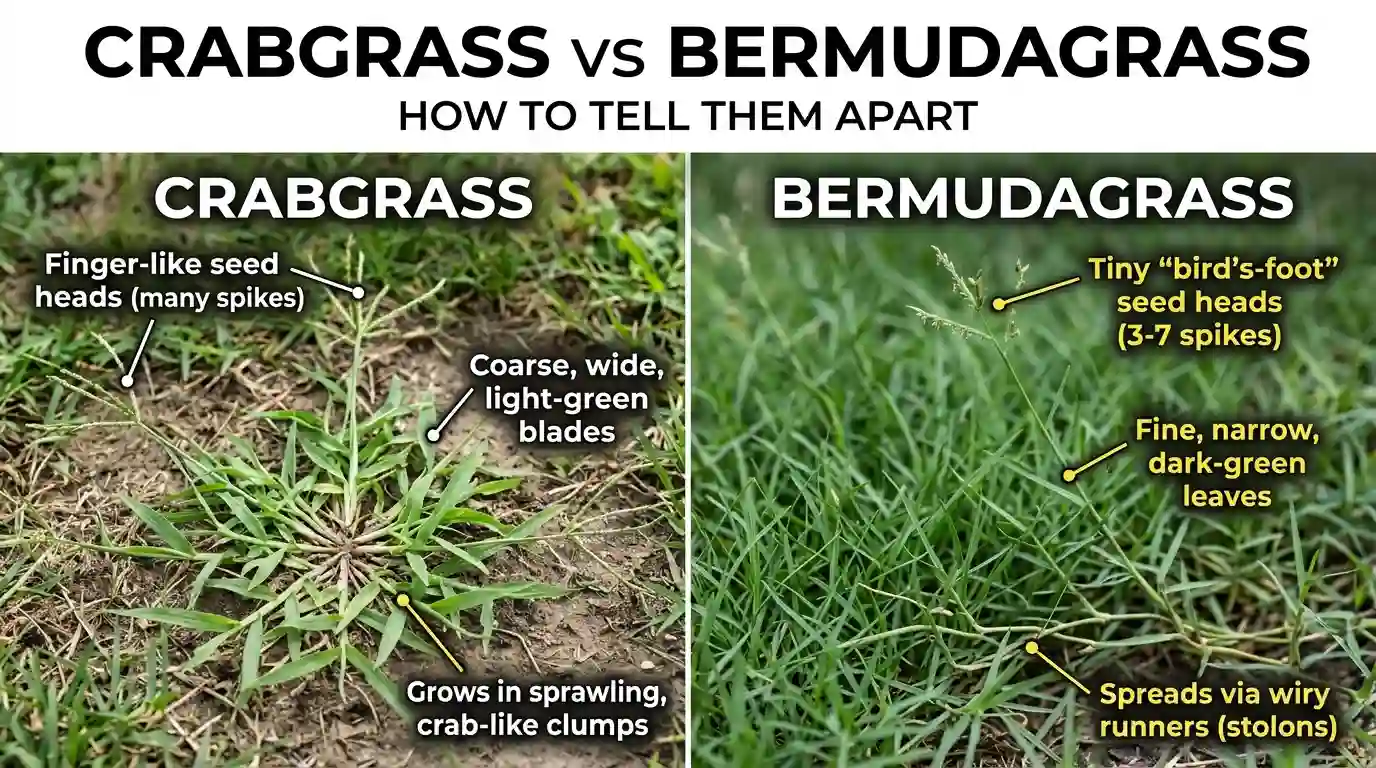
You look at your lawn. You see a patch of grass that looks odd. It grows fast. It looks wider than the rest. You wonder if it is crabgrass or Bermudagrass.
This is a common problem. Many people mix these two grasses up. Both love the heat. They spread fast, and you will find them in sunny spots. But they are not the same plant.
One is a weed. The other is a lawn grass that many people plant on purpose.
In this guide, you will learn the difference between crabgrass and Bermuda grass. You will learn how to spot each one. You will learn when each one grows, and what to do about it. The words are simple. The steps are clear. Let’s begin.
Quick Answer: What Is the Difference?
Here is the short version.
Crabgrass is a summer annual weed. It lives for one season. Its blades are wide and pale, and it grows in clumps. When the first frost comes, it dies.
Bermudagrass is a perennial grass. It lives for many years. Its blades are thin and fine, and it spreads with runners. Each spring, it comes back.
Keep these three clues in mind:
- Crabgrass blades are wide. Bermudagrass blades are thin.
- Crabgrass grows in clumps. Bermudagrass spreads in a mat.
- Crabgrass dies in fall. Bermudagrass turns brown in winter and wakes in spring.
Now let’s look at each grass in more detail.
Is Bermuda Grass the Same as Crabgrass?

No. Is Bermuda grass the same as crabgrass? It is a fair question. The two plants share a few things. But they are two different grasses. They look close when they are young. Both have green blades. They grow low, and they like the sun. So it is easy to mix them up. But their life stories are not alike. Crabgrass grows from seed each year and then dies. Bermuda grass grows back from the same roots year after year. One is a short visit. The other is a long stay.
Their names also help. Crabgrass is a weed name. Bermuda grass is a lawn grass name. Nobody plants crabgrass on purpose in a lawn. Many people plant Bermuda on purpose.
What Is Crabgrass?
Crabgrass is a warm-season weed.It grows fast in summer. Sun and heat are what it loves, and it likes thin lawns and bare soil.
Crabgrass is an annual. That means it grows from a seed each year. It sprouts in spring. All summer it keeps growing, and it makes a huge number of seeds. Then it dies when the cold arrives.
A single plant can make up to 150,000 seeds. These seeds can sit in the soil for years. Experts call this the seed bank. Next spring, many of those seeds sprout. This is why crabgrass keeps coming back, even though each plant only lives one season.
The name comes from its shape. The stems spread out from one central point, called the crown. They lie low and wide, like the legs of a crab. That flat, low shape is called a prostrate habit. If left alone, a plant can grow up to about two feet across.
There are two common kinds. Smooth crabgrass has a smooth blade. Large crabgrass has a hairy blade. Both are weeds in a lawn.
Crabgrass is not harmful to touch. But most people do not want it in a lawn. It looks messy. It crowds out good grass. And it leaves bare spots when it dies.
When Does Crabgrass Start to Grow?
Timing is the key to crabgrass. If you know when it wakes up, you can plan.
Crabgrass seeds sprout when the soil warms up. The magic number is about 55 degrees. This is the soil temperature a few inches down, not the air. When the soil stays near 55 degrees for several days, the seeds start to wake. In many places, this happens in spring.
After that, crabgrass grows fast. By mid-summer, it is large. Seed heads appear in late summer, and then it dies in fall.
A cheap soil thermometer is a handy tool. Push it a few inches into the ground in the morning. Check it each week in early spring. When it nears 55 degrees, it is time to act. Your local weather service or garden center may also share soil temperature data for your area. Some lawn sites also give a lawn calendar based on your ZIP code.
Is Crabgrass Bad?
Many people ask, “Is crabgrass bad?” The answer depends on where it grows.
In a lawn, crabgrass is a problem. Here is why.
It takes space. Crabgrass grows in clumps. It pushes out the grass around it. Your lawn gets thinner.
It takes water and food. Crabgrass drinks a lot. Your good grass gets less.
It looks different. The wide, pale blades stand out. The lawn looks patchy.
It leaves gaps. When crabgrass dies in fall, it leaves bare soil. Then more weeds can move in.
It spreads seeds. One plant can make a huge number of seeds. They wait in the soil for next year.
So yes, crabgrass is bad for a neat lawn. But it is not dangerous. It is just a weed that you can manage.
Is Crabgrass Good for Anything?
Here is a fun fact. In some farm settings, crabgrass is not a weed at all. Some farmers grow it as feed for cattle and horses. It grows fast in summer, when other pastures slow down. It can be cut and dried as hay.
So crabgrass has a use. But a lawn is not a pasture. In a lawn, it is still the wrong plant in the wrong place.
What Is Bermudagrass?
Bermudagrass is a warm-season turfgrass. It grows well in hot, sunny places, including humid and subtropical areas. It is very common in the southern United States. People plant it in lawns, parks, golf courses, and athletic fields. It handles heat very well. Foot traffic is no problem for it either, and it also handles dry spells and salty soil better than many grasses.
Bermudagrass is a perennial. That means it lives for many years. It goes brown in winter. This is called dormancy. It is not dead. It is just resting. When warm weather returns, it turns green again.
This grass spreads in two ways. It sends out runners above the ground. These are called stolons. It also sends out runners below the ground. These are called rhizomes. The runners root again at each joint, called a node. This is how it fills in a lawn so fast, and why it holds on so tightly.
A healthy Bermuda lawn looks thick and soft. It forms a tight green carpet. Many homeowners love it for this reason. Bermuda has a medium texture, so it is not as soft as some grasses on bare feet.
Common Bermuda vs Hybrid Bermuda
Not all Bermuda grass is the same. There are two main groups.
Common Bermuda is the tougher, older type. You can grow it from seed. It is a bit coarser and often cheaper. Because it can spread more freely, it can also sneak into places you do not want.
Hybrid Bermuda is a bred type.It has finer blades and grows denser. Looking neater is part of its appeal, but it usually does not grow from seed. You plant it as sod or sprigs. It often needs more care, like more feeding and more mowing.
Which is better? If you want a tidy, fine lawn, hybrid is a strong pick. If you want low cost and easy seeding, common Bermuda may fit. Ask your local garden center which types grow well in your area.
Bermuda Grass Care Basics
A healthy Bermuda lawn is the best shield against weeds. Here are the basics.
Sun. Bermuda loves full sun. It can handle a little shade, but it thins out in too much.
Soil. It likes fertile soil. A simple soil test tells you what your lawn needs.
Mowing. In the growing season, mow often. Twice a week gives a tidy, dense lawn. Keep the height steady.
Feeding. Feed it about once a month during the growing season.
Watering. Give it about one inch of water each week. Water early in the morning. Bermuda handles dry spells well, but it looks best with steady water in the heat of summer.
Edges and beds. Mulch your garden beds and plant them densely. This helps keep Bermuda out.
Follow these steps, and your lawn will crowd out most weeds on its own.
Is Bermudagrass Good or Bad?
Bermudagrass is tricky. In the right place, it is great. In the wrong place, it is a pest.
Where Bermudagrass is good:
- Full-sun lawns
- Sports fields and golf courses
- Parks and play areas
- Hot, dry areas
It stays green in the heat. Repairing itself is something it does fast, and it stands up to kids and pets.
Where Bermudagrass is a problem:
- In flower beds
- In vegetable gardens
- Inside other types of lawn grass, such as fescue
- Along walkways and in cracks
Here it spreads where you do not want it. It is hard to stop once it starts. The runners go deep. Even a small piece left in the soil can grow back.
One more note. Bermuda grass makes pollen. For some people with allergies, this can cause sneezing in summer. If this is you, keep the lawn mowed. Mowing keeps the plants from making many seed heads.
So Bermudagrass is not bad. It is just in the wrong place sometimes.
How to Plant Bermuda Grass
If you want a Bermuda lawn, you have three ways to start. Each has pros and cons.
Seed. This is the cheapest way. It works for common Bermuda. It takes longer to fill in. You need to keep the soil damp while seeds sprout.
Sod. This is a roll of ready grass. It gives you a lawn fast. It costs more. You must water it well at first so the roots can grab the soil.
Sprigs or plugs. These are small pieces of grass with roots. You plant them in rows or spots. They spread over time. This is a good middle path. It is also how most hybrid Bermuda is planted.
Whichever way you choose, plant in late spring or early summer. Bermuda loves warm soil. Plant it in full sun. Prepare the soil first. Remove weeds. Loosen the ground. Water often until the grass is firm.
A thick new lawn is also your best weed shield. Dense grass leaves no room for crabgrass to sprout.
What Do Crabgrass and Bermudagrass Have in Common?
They look different up close. But they share a few traits.
- Both are warm-season plants.
- Both love full sun.
- Both grow best in the heat.
- Both stand up to foot traffic.
- Both can sprout in cracks, along driveways, and in bare spots.
- Both slow down in cold weather.
These shared traits explain why people mix them up. They grow in the same places at the same time. That is why you need to look at the details.
Crabgrass Identification: How to Spot It
Good crabgrass identification starts with a close look. Get down low. Look at the blades, the stems, and the shape of the plant.
Blade Width
Crabgrass blades are wide. They are flat and a bit rough. They often look like small pieces of tape.
Color
The color is a pale, light green. It often looks yellow-green. It stands out from darker lawn grass.
Growth Shape
Crabgrass grows in a clump, also called a rosette. The stems start at one center point. Then they spread out like the arms of a star. They often lie flat on the ground. It can look like it was stepped on.
Roots
Crabgrass has shallow roots. It lifts out with one pull. You can often pull it out in one shallow piece.
Season
It shows up late in spring. Summer is when it grows fastest, and in fall it turns purple or brown.Then it dies at first frost.
Where It Shows Up First
Look at the edges of your driveway and sidewalk. Look at thin, sunny spots. The soil there warms up fast. Crabgrass loves these places.
Bermudagrass Identification: How to Spot It
Now let’s look at Bermudagrass.
Blade Width
Bermudagrass blades are thin and fine. They feel soft. They are much smaller than crabgrass blades.
Color
The color is a deeper green. Some types look blue-green. The whole patch looks even and smooth.
Growth Shape
Bermudagrass does not grow in a clump. It spreads in a mat. You can see runners crawling over the ground. This is a key clue.
Roots
Bermudagrass has strong, deep roots. It does not budge when you pull it. The runners above the ground hold it firm. The ones below hold it even tighter.
Season
It turns green in spring. It stays green all summer. In winter, it turns tan or brown. It rests until spring.
The Collar Test: A Closer Look
Here is a trick for people who want to be sure. Look at the spot where the blade meets the stem. This spot is called the collar.
On crabgrass, you will see a tall, thin, paper-like flap called a ligule. It stands up against the stem. On large crabgrass, the lower blade and sheath may feel hairy.
On Bermudagrass, you will see a ring of fine, white hairs. There is no tall paper-like flap.
Bend a blade back gently. Look at the collar. This tiny clue can settle the question.
Is It Crabgrass? Is It Bermudagrass? Two Quick Checklists
It is likely crabgrass if:
- It lifts out of the soil in one piece.
- The blades are wide, flat, and lighter than the grass around them.
- The stems fan out from one center point.
- It showed up this spring and was not there last fall.
- It disappears after the first hard frost.
It is likely Bermudagrass if:
- You cannot pull it up.
- The blades are fine and narrow.
- The patch is a mat, not a clump.
- You can see runners crossing bare soil or sidewalks.
- The same spot turned green again this spring after going brown.
Crabgrass vs Bermuda Grass Pictures: What to Look For

Many people search for crabgrass vs Bermuda grass pictures. Pictures help a lot. But you can also learn to see the signs in your own yard.
Picture this in your mind.
Crabgrass: A pale green clump. Wide blades. Stems spread out from the middle like a star. It sits low and flat.
Bermudagrass: A dark green mat. Thin blades. Long runners crawl across the ground. The patch looks smooth and tight.
If you look at your lawn and see a lone clump with wide blades, think crabgrass. If you see a spreading mat with fine blades and runners, think Bermudagrass.
A tip: take your own photo. Put it next to a trusted picture online. Compare the blades and the shape. This makes it much easier. Look at pictures taken in good light, close up and from above.
Side-by-Side Comparison
Here is a simple chart. It shows the main differences between crabgrass and Bermuda grass.
| Feature | Crabgrass | Bermudagrass |
|---|---|---|
| Life cycle | Summer annual (one season) | Perennial (many years) |
| Blade width | Wide and flat | Thin and fine |
| Texture | Coarse and rough | Medium and softer |
| Color | Pale, yellow-green | Deep green or blue-green |
| Growth shape | Clump (rosette) | Spreading mat |
| How it spreads | Seed only | Stolons, rhizomes, and seed |
| Roots | Shallow | Deep and strong |
| Pull test | Lifts out easily | Hard to pull |
| Collar | Tall, paper-like ligule | Ring of fine white hairs |
| In winter | Dies | Turns brown, then returns |
| Role in lawn | Weed | Lawn grass |
Save this chart. Use it when you are not sure.
Seed Heads: Bermuda Grass Seed Head vs. Crabgrass Seed Head
Seed heads show up in summer. They sit on tall stems above the plant. Many people look at them to tell the two grasses apart.
Here is the catch. The two seed heads look a lot alike. Both have finger-like spikes. Crabgrass often has three to five or more. Bermuda has about three to seven. Both spread out from one point at the top of the stem.
So a Bermuda grass seed head vs. crabgrass seed head test does not work well on its own. Do not rely on it.
Look at the rest of the plant instead.Check the blade width and the growth shape. The roots are worth a look too. Those clues are much clearer.
The Pull Test
Here is an easy test you can do right now. It takes two minutes.
- Pick a plant you want to check.
- Grab it near the base.
- Pull it gently.
If it lifts out in one piece, it is likely crabgrass. The roots are shallow.
If it will not budge, it is likely Bermudagrass. The runners hold it in place. You may see a long runner come up with it.
Be gentle. Do not tear up your lawn. This test is just a quick way to learn what you have.
Not sure in summer? Wait for winter. Crabgrass dies and leaves a bare spot. Bermuda just turns tan and comes back.
Growth Rate: Which One Grows Faster?
Both grasses grow fast in the heat. So the growth rate is close to a tie.
Crabgrass grows fast from seed. It can take over a thin spot in one summer. But it only lives one season.
Bermudagrass spreads fast with runners. It can fill a whole lawn in one or two seasons. And it keeps growing back each year.
So the main difference is not speed. It is how long they last. Crabgrass is here for one summer. Bermudagrass is here to stay.
Can Bermuda Overtake Crabgrass?
Yes, it can. A strong Bermuda lawn can beat crabgrass over time.
Here is how it works. Bermuda grows thick. Its runners fill every gap. When the lawn is dense, crabgrass seeds cannot reach the soil. They have no room to sprout. The shade from the thick grass also keeps the soil cooler. Crabgrass needs warm soil to sprout well.
But this only works if your Bermuda is healthy. A thin or weak Bermuda lawn gives crabgrass an open door. Bare spots invite weeds.
So the best way to let Bermuda win is to help it. Feed it. Water it deeply. Mow it at the right height. Fill in thin spots. A thick lawn is the best defense.
Why Does Crabgrass Grow in a Bermuda Lawn?
Crabgrass can grow in a Bermuda lawn. Many people see this. But why does it happen?
Crabgrass likes open space. If your Bermuda lawn has thin spots, crabgrass moves in. It also loves:
- Bare soil
- Short mowing
- Weak or thin grass
- Light, frequent watering
- Soil that heats up fast
A thick Bermuda lawn is the best defense. When the grass is dense, the seeds cannot reach the soil.
So a thin lawn is an open door. A thick lawn is a closed door.
Why Does My Bermuda Lawn Look Like Crabgrass?
Sometimes your Bermuda lawn looks like it has crabgrass. But it may be just Bermuda. Here are two reasons.
Mowing too high. When Bermuda grows too tall, it gets stemmy and coarse. It can look like a weed.
Real crabgrass is hiding in it. Both grasses peak in July. Crabgrass is easy to miss. Look in flat morning light. Crabgrass clumps look paler. They sit a bit higher than the grass around them after a mow.
Then pull one. Bermuda holds on. Crabgrass lifts out.
How to Control Crabgrass in Bermuda Grass
Here is the big question. How do you control crabgrass in Bermuda grass? Follow these steps. Each one helps.
Step 1: Keep the Lawn Thick
A thick lawn is your best tool. Feed your Bermuda grass in the growing season. Water it well. Fill in any thin spots. Dense grass blocks weeds.
Step 2: Mow at the Right Height
Do not cut too short. Short grass lets in sun. Sun helps crabgrass seeds sprout. For most Bermuda lawns, aim for one to two inches. Check the best height for your type of Bermuda. During the growing season, mow often.
Step 3: Water Deeply
Water deep and less often. About one inch of water each week is a good goal in hot months. This builds strong roots. Light, daily watering helps crabgrass more than your lawn.
Step 4: Use a Pre-Emergent Product in Spring
A pre-emergent is a product that stops seeds from sprouting. Put it down in early spring. Do it before the soil reaches about 55 degrees. It must be in place before the seeds wake up. Always read the label. Follow the steps on the pack.
Step 5: Pull Small Weeds by Hand
If you see a few crabgrass plants, pull them out. Do it before they make seeds. The shallow roots make this easy. Pull after rain, when the soil is soft.
Step 6: Use a Post-Emergent Product If Needed
If crabgrass is already growing, you may need a post-emergent product. Choose one that is safe for Bermuda grass. Not all products are safe. Read the label with care. Apply it on a calm day. Follow all the directions.
Step 7: Keep Going for Two or Three Years
One good spring is not enough. Seeds stay in the soil for years. Two or three seasons of good timing will wear down the seed bank. Skip one spring, and you can undo a lot of work.
Crabgrass Killer: What to Know Before You Buy
Many people search for a crabgrass killer. These products can help. But the choice matters a lot.
Here are some simple rules.
Read the label first. Some products are safe for Bermuda grass. Some are not. The same ingredient can be fine on one grass and harmful on another.
Match the product to your grass. A product that works on your neighbor’s lawn may harm yours. Check your grass type.
Choose the right type. Pre-emergent products stop seeds before they sprout. Post-emergent products work on plants that are already growing. Pre-emergent in spring is usually the best plan.
Know the common examples. Barricade is a well-known pre-emergent. Drive XLR8 is a post-emergent made with quinclorac. These are only examples. Check that the label for any product lists your grass type.
Follow the rate. More is not better. Use the amount on the label.
Time it well. Young crabgrass is much easier to control than big, old crabgrass.
Ask for help. A local garden center, your local extension office, or a licensed lawn care pro can point you to a safe choice for your area.
How to Get Rid of Bermuda Grass Where You Do Not Want It
Sometimes Bermudagrass grows in the wrong place. It may creep into a flower bed or a garden. Here is how to handle it. This is a long job. Be patient.
Dig It Out
Use a garden fork. Loosen the soil. Lift out the runners. Get as much of the root as you can. Even small pieces can grow back, so be thorough.
Do Not Just Pull It
Pulling Bermuda grass by hand often breaks the runners. The pieces left behind can grow into new plants. In a flower bed, hand work can help. In a lawn, it rarely finishes the job.
Block It With an Edge
Put a deep edge between your lawn and your beds. Metal or plastic edging works well. Sink it at least six inches deep. This stops the runners.
Cover the Area
You can cover the area with thick layers of cardboard and mulch. Leave it for a full season. This blocks light. The grass runs out of energy.
Mulch Your Beds
A thick layer of mulch helps keep Bermuda out of beds. Dense planting helps too.
Be Patient
Bermudagrass is tough. It may take more than one try. Keep checking the area. Remove new shoots right away. In time, it will fade.
Bermuda Grass Killer: Does It Work?

A Bermuda grass killer can help in some cases. But this grass is tough. One dose may not be enough. Some products, such as those with glyphosate, are not picky. They can harm the plants you want to keep, too. Many people need a few rounds over time.
Here are a few tips.
- Read the label and follow it step by step.
- Take care around plants you want to keep.
- Expect to repeat the job.
- Act before the grass sets seed.
- Ask a lawn care pro if Bermuda has spread deep into your lawn.
Bermuda in a cool-season lawn, such as fescue, is one of the hardest lawn problems. Many people choose between living with it, setting a hard edge, or renovating the whole area. Be sure you are dealing with Bermuda first. What looks like Bermuda in a fescue lawn is often crabgrass. And crabgrass is much easier to fix.
Bermuda Winter Dormancy and Spring Scalping
Bermuda grass turns tan in winter. Do not panic. It is not dead. It is resting.
When the weather cools, the blades stop growing and fade. The roots stay alive. In spring, as the soil warms, new green shoots come up.
Many Bermuda growers do a spring “scalp.” This means a low mow in early spring, just before the grass wakes up.It removes the dead, tan blades and lets sun reach the soil. That helps the new green grass come in clean.
Some tips for scalping:
- Wait until the last hard frost has passed.
- Lower the mower and cut once, close to the soil.
- Bag or rake the clippings.
- Then feed and water as the grass starts to green up.
Do not scalp too early. A late cold snap can harm new shoots. And do not scalp a weak lawn. Also, remember that scalping opens up the soil. If you plan to use a pre-emergent, put it down in the same window, so crabgrass seeds do not get a chance.
Crabgrass vs Quackgrass
Crabgrass and quackgrass are both weeds. But they are not the same.
Crabgrass: It likes hot weather. It is an annual that grows from seed each year. Its roots are shallow.
Quackgrass: It likes cool weather. It is a perennial, and it spreads with white, creeping roots under the ground. Its blades are long and flat.
So how do you tell them apart? Think about the season. If the weed booms in the heat of summer, it is likely crabgrass. If it grows strong in the cool days of spring and fall, it may be quackgrass. Check the roots too. White, creeping roots point to quackgrass.
Other Look-Alike Weeds: Goosegrass, Dallisgrass, Clover, and Oxalis
A few more weeds get mixed up with crabgrass or other lawn plants.
Goosegrass looks a lot like crabgrass. It grows in a flat, low rosette. The key clue is the center of the plant. It looks pale, silvery, or white. It likes hard, packed soil, such as paths and worn spots. Crabgrass does not have that pale center.
Dallisgrass grows in tough clumps. The blades are coarse. It grows in a tuft that gets bigger each year. Unlike crabgrass, it is a perennial. It comes back from the same roots.
Clover and oxalis are not grasses. They are broadleaf plants. But people often mix them up when a lawn looks patchy. Clover has rounded leaves in threes. Oxalis has heart-shaped leaflets. Neither has narrow grass blades.
If a weed in your lawn does not match crabgrass, check these next.
Bermuda Grass vs St. Augustine
Bermuda and St. Augustine are both lawn grasses. Both like warm weather. But they are different.
Bermuda grass: Fine blades. Loves full sun. Handles heavy foot traffic. Recovers fast. Goes brown in winter. Handles dry spells well.
St. Augustine grass: Wide, flat blades. Handles some shade better. Likes warm, humid places. Forms a thick, coarse mat. Does not handle heavy foot traffic as well.
If your yard has lots of sun and lots of play, Bermuda is a strong pick. If your yard has some shade, St. Augustine may do better.
The same weed control product can act differently on each grass. Always check the label for your grass type.
What Is Better Than Bermuda Grass?
There is no one best grass. It depends on your yard.
Bermuda is a great choice for sun and heavy use. But other grasses may fit better in some cases. Here is a quick look.
Zoysia grass: It grows slower than Bermuda.It forms a dense, soft lawn and handles some shade. Less mowing is needed, but it takes longer to fill in.
Fescue: This is a cool-season grass. It does well where winters are cold and summers are mild. Extreme heat is not its friend, which makes it a poor fit for very hot places.
Centipede grass: It is a slow, low-care grass.It likes warm weather and acidic soil. Heavy foot traffic is hard on it, so it is a fit for a calm yard.
St. Augustine and carabao grass: Both handle shade better than Bermuda.
Think about the sun in your yard and the weather. Then consider how you use the lawn. Then pick the grass that fits.
Which Is Better: Bermuda or Carabao Grass?
Carabao grass is a wide-bladed lawn grass. It grows low and spreads across the ground. People often use it in warm, wet places.
Here is how the two compare.
| Feature | Bermuda Grass | Carabao Grass |
|---|---|---|
| Blades | Thin and fine | Wide and flat |
| Sun | Loves full sun | Handles sun and some shade |
| Shade | Weak in shade | Better in shade |
| Foot traffic | Very strong | Fair |
| Dry spells | Handles well | Needs more water |
| Look | Dense, fine carpet | Softer, broader look |
So which is better? If you want a tough lawn for play and full sun, pick Bermuda. If your yard has some shade or stays damp, carabao grass may be a better fit.
Local Names and Common Mix-Ups
In some places, lawn grasses go by local names. You may hear “Dhaka grass,” “fine Dhaka grass,” or “American grass.” Names like these vary from nursery to nursery. They may not match the names in a book.
That makes it easy to get confused when you compare Bermuda grass vs Dhaka grass, or Bermuda grass vs American grass. Here is a simple fix. Ask the seller for the botanical name. Look at the blade width. Check how the grass spreads. Then compare it to the clues in this guide.
You may also hear people ask about the crab grass meaning in Urdu. The plain meaning is a wild summer grass that grows as a weed. Many people just use the English name.
Common Mistakes to Avoid
Many people make the same errors. Avoid these and you will save time.
Mowing too short. Short grass helps weeds. Keep your mowing height steady.
Watering a little each day. This keeps the top soil damp. Weed seeds love that. Water deep instead.
Skipping spring care. The best time to stop crabgrass is before it sprouts. Do not wait for summer.
Using the wrong product. Some weed products harm Bermuda grass. Always check the label first.
Pulling Bermudagrass by hand in a lawn. This often leaves bits of runner behind. They grow back.
Judging by the seed head. Both grasses have similar seed heads. Look at the blades and the shape.
Scalping too early. A late cold snap can harm new Bermuda shoots.
Giving up too soon. Lawn care takes time. Stay with it for a full season.
A Simple Yearly Plan
Here is an easy plan. Follow it through the year.
Early Spring: Check the soil temperature. Apply a pre-emergent product before it reaches about 55 degrees. Rake off dead leaves. Check for thin spots. After the last hard frost, scalp Bermuda grass if you wish.
Late Spring: Feed your Bermuda lawn. Start mowing at the right height. Water deep. This is also a good time to plant new Bermuda.
Summer: Mow often. Pull any weeds that appear. Keep the lawn thick. Watch for crabgrass clumps.
Early Fall: Pull any last weeds. Fill thin spots. Stop feeding as the weather cools.
Winter: Rest. Your Bermuda grass will turn brown. This is normal. Plan for next spring.
Which One Should You Choose?
You may wonder which grass you want. It depends on the goal.
Choose Bermudagrass if you want:
- A strong lawn
- A grass that loves heat
- A lawn that handles play and pets
- Grass that comes back each year
Do not choose crabgrass. It is a weed, so it does not make a good lawn. Each fall it dies and leaves bare spots.
If you already have crabgrass, do not worry. A few steps will help. Build a thick lawn. Use a pre-emergent in spring. Pull small weeds. In time, your lawn will get better.
Frequently Asked Questions
No. They are two different plants. Bermuda grass is a perennial lawn grass. Crabgrass is a summer annual weed.
The blades. Crabgrass has wide, pale blades. Bermuda grass has thin, fine blades. Crabgrass also grows in clumps. Bermuda grass spreads in a mat.
Yes, in most cases. It crowds out good grass and uses up water and food. When it dies, it leaves bare spots.
It sprouts when the soil, a few inches down, stays near 55 degrees for several days. This is usually in spring.
Not in the same way. Crabgrass spreads mostly by seed. Bermuda grass spreads with runners above and below the ground, and also by seed.
Yes, a thick, healthy Bermuda lawn can crowd out crabgrass. A thin Bermuda lawn gives crabgrass room to grow.
No. A plant cannot change into another type. They may grow side by side. That can make them look like one plant.
Crabgrass dies each fall. But its seeds stay in the soil. They sprout again in spring. So it seems to come back.
The best time is early spring. Use a pre-emergent product before the seeds sprout. This works better than waiting until summer.
It depends on the product. Some are safe for Bermuda. Some are not. Read the label for your grass type before you use it.
Yes. It has strong runners above and below the ground. It takes time and care to remove.
Common Bermuda can grow from seed and is a bit coarser. Hybrid Bermuda has finer blades and a denser look. It is usually planted as sod or sprigs.
You can use seed, sod, or sprigs. Plant in late spring or early summer in full sun, and keep the soil damp until the grass takes hold.
In the growing season, mow often, even twice a week. Give it about one inch of water each week.
It is going dormant. The roots stay alive. It turns green again in spring.
It depends on your yard. For shade, try St. Augustine, zoysia, or carabao grass. Fescue is a good pick for cool weather, and centipede or zoysia suit low upkeep.
Bermuda is better for full sun and heavy use. Carabao grass is better for shade and damp spots.
Do the pull test. Crabgrass lifts out easily. Bermuda grass holds firm. Then check the blades. Wide blades mean crabgrass. Thin blades mean Bermuda.
Final Thoughts
Crabgrass and Bermudagrass look alike at first. But they are very different.
Crabgrass is a one-season weed. It has wide, pale blades. It grows in clumps and lifts out with ease.
Bermudagrass is a lasting lawn grass. It has thin, fine blades. It spreads with runners and holds firm.
Now you know how to spot each one. You know when crabgrass wakes up. Planting and caring for Bermuda is no mystery to you now, and you know how to keep your lawn thick. Mow at the right height. Water deep. Act in spring. These small steps make a big change.
Take a walk around your yard today. Look close. Try the pull test. You may be surprised at what you find.
A healthy lawn starts with knowing your grass. Now you do.

Jessica Morgan writes easy-to-understand guides about grass varieties, lawn care, growing conditions, and seasonal lawn maintenance. She focuses on practical information that helps readers identify different grasses, understand their needs, and make better choices for healthy lawns.